Tag: USGA

  • Tee Times for 119th US Open Championship at Pebble Beach

    Tee Times for 119th US Open Championship at Pebble Beach

    The United States Golf Association announced the tee times for the first two rounds of the 2019 U.S. Open Championship, starting on Thursday, June 13th and Friday, June 14th, 2019 at the 7,075-yard, par-71 Pebble Beach Golf Links. The field of 156 players will play 36 holes of stroke play, after which the field will be reduced to the low 60 scores and ties.

    If there is a tie after 72 holes, a two-hole aggregate playoff will immediately follow. This is a new playoff format that became effective in 2018. If this playoff results in a tie, the tied players will immediately continue to play off hole-by-hole until the winner is determined. The USGA stated this change was because of a desire for a Sunday finish.

    All Times Pacific Daylight Time

    Thursday (June 13, 2019), Hole #1 / Friday (June 14, 2019), Hole #10

    6:45 a.m. / 12:30 p.m. – Sam Saunders, Atlantic Beach, Fla.; Carlos Ortiz, Mexico; Marcus Fraser, Australia

    6:56 a.m. / 12:41 p.m. – TBD; Erik Van Rooyen, South Africa; (a) Chun An Yu, Chinese Taipei

    7:07 a.m. / 12:52 p.m. – Ryan Fox, New Zealand; Thorbjorn Olesen, Denmark; TBD

    7:18 a.m. / 1:03 p.m. – Scottie Scheffler, Dallas, Texas; (a) Matt Parziale, Brockton, Mass.; Nick Taylor, Canada

    7:29 a.m. / 1:14 p.m. – Patton Kizzire, Sea Island, Ga.; (a) Jovan Rebula, South Africa; Jason Dufner, Auburn, Ala.

    7:40 a.m. / 1:25 p.m. – Haotong Li, People’s Republic of China; Bubba Watson, Bagdad, Fla.; J.B. Holmes, Lexington, Ky.

    7:51 a.m. / 1:36 p.m. – Zach Johnson, Cedar Rapids, Iowa; Martin Kaymer, Germany; Ernie Els, South Africa

    8:02 a.m. / 1:47 p.m. – Si Woo Kim, Republic of Korea; Rickie Fowler, Murrieta, Calif.; Jason Day, Australia

    8:13 a.m. / 1:58 p.m. – Shane Lowry, Republic of Ireland; Tyrrell Hatton, England; Gary Woodland, Topeka, Kan.

    8:24 a.m. / 2:09 p.m. – Cameron Smith, Australia; Matthew Wallace, England; Xander Schauffele, San Diego, Calif.

    8:35 a.m. / 2:20 p.m. – C.T. Pan, Chinese Taipei; Abraham Ancer, Mexico; (a) Brandon Wu, Scarsdale, N.Y.

    8:46 a.m. / 2:31 p.m. – Chan Kim, Gilbert, Ariz.; Justin Walters, South Africa; TBD

    8:57 a.m. / 2:42 p.m. – Nick Hardy, Northbrook, Ill.; (a) Noah Norton, Chico, Calif.; Andreas Halvorsen, Norway

    Thursday (June 13, 2019), Hole #10 / Friday (June 14, 2019), Hole #1

    6:45 a.m. / 12:30 p.m. – (a) Luis Gagne, Orlando, Fla.; Sepp Straka, Valdosta, Ga.; Julian Etulain, Argentina

    6:56 a.m. / 12:41 p.m. – Dean Burmester, South Africa; TBD; Kyounghoon Lee, Republic of Korea

    7:07 a.m. / 12:52 p.m. – Clement Sordet, France; Tom Hoge, Fargo, N.D.; Adri Arnaus, Spain

    7:18 a.m. / 1:03 p.m. – Brian Davis, Windermere, Fla.; (a) Kevin O’Connell, Jacksonville, Fla.; Billy Hurley III, Annapolis, Md.

    7:29 a.m. / 1:14 p.m. – Brendon Todd, Watkinsville, Ga.; Luke Donald, England; Mike Weir, Canada

    7:40 a.m. / 1:25 p.m. – Kyle Stanley, Gig Harbor, Wash.; Billy Horschel, Ponte Vedra, Fla.; Danny Willett, England

    7:51 a.m. / 1:36 p.m. – Jon Rahm, Spain; Marc Leishman, Australia; Rory McIlroy, Northern Ireland

    8:02 a.m. / 1:47 p.m. – Justin Thomas, Louisville, Ky.; Kevin Kisner, Aiken, S.C.; Bryson DeChambeau, Clovis, Calif.

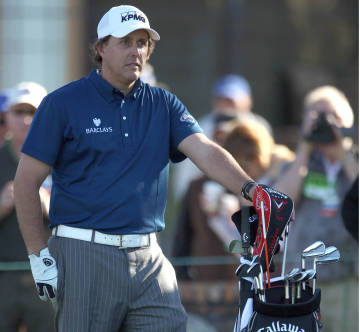
    8:13 a.m. / 1:58 p.m. – Dustin Johnson, Jupiter, Fla.; Phil Mickelson, Rancho Santa Fe, Calif.; Graeme McDowell, Northern Ireland

    8:24 a.m. / 2:09 p.m. – Hideki Matsuyama, Japan; Sergio Garcia, Spain; Tommy Fleetwood, England

    8:35 a.m. / 2:20 p.m. – Jhonattan Vegas, Venezuela; Patrick Reed, Houston, Texas; Louis Oosthuizen, South Africa

    8:46 a.m. / 2:31 p.m. – Rob Oppenheim, Andover, Mass.; Rhys Enoch, Wales; Richard Lee, Bellevue, Wash.

    8:57 a.m. / 2:42 p.m. – Andy Pope, Glen Ellyn, Ill.; Ryan Sullivan, Winston-Salem, N.C.; Matthew Naumec, Wilbraham, Mass.

    Thursday (June 13), Hole #1 / Friday (June 14), Hole #10

    12:30 p.m. / 6:45 a.m. – Rory Sabbatini, Slovakia; Sam Horsfield, England; Roberto Castro, Atlanta, Ga.

    12:41 p.m. / 6:56 a.m. – (a) Cameron Young, Scarborough, N.Y.; Marcus Kinhult, Sweden; Brian Stuard, Jackson, Mich.

    12:52 p.m. / 7:07 a.m. – Luke Guthrie, Jacksonville Beach, Fla.; Joseph Bramlett, San Jose, Calif.; Charlie Danielson, Osceola, Wis.

    1:03 p.m. / 7:18 a.m. – (a) Austin Eckroat, Edmond, Okla.; Alexander Noren, Sweden; Charles Howell III, Orlando, Fla.

    1:14 p.m. / 7:29 a.m. – Thomas Pieters, Belgium; Chesson Hadley, Raleigh, N.C.; (a) Stewart Hagestad, Newport Beach, Calif.

    1:25 p.m. / 7:40 a.m. – Paul Casey, England; Patrick Cantlay, North Palm Beach, Fla.; Lucas Glover, Jupiter, Fla.

    1:36 p.m. / 7:51 a.m. – Kiradech Aphibarnrat, Thailand; Keith Mitchell, Chattanooga, Tenn.; Shugo Imahira, Japan

    1:47 p.m. / 8:02 a.m. – Francesco Molinari, Italy; (a) Viktor Hovland, Norway; Brooks Koepka, West Palm Beach, Fla.

    1:58 p.m. / 8:13 a.m. – Tony Finau, Lehi, Utah; Jimmy Walker, Boerne, Texas; Ian Poulter, England

    2:09 p.m. / 8:24 a.m. – Jordan Spieth, Dallas, Texas; Justin Rose, England; Tiger Woods, Hobe Sound, Fla.

    2:20 p.m. / 8:35 a.m. – Daniel Berger, Jupiter, Fla.; Matthew Jones, Australia; Kodai Ichihara, Japan

    2:31 p.m. / 8:46 a.m. – Matthieu Pavon, France; (a) Chandler Eaton, Alpharetta, Ga.; Callum Tarren, England

    2:42 p.m. / 8:57 a.m. – Eric Dietrich, Cheshire, Conn.; Guillermo Pereira, Chile; Brett Drewitt, Australia

    Thursday (June 13), Hole #10 / Friday (June 14), Hole #1

    12:30 p.m. / 6:45 a.m. – Nathan Lashley, Scottsdale, Ariz.; Renato Paratore, Italy; Lee Slattery, England

    12:41 p.m. / 6:56 a.m. – TBD; Collin Morikawa, La Canada Flintridge, Calif.; Aaron Wise, Las Vegas, Nev.

    12:52 p.m. / 7:07 a.m. – Merrick Bremner, South Africa; Chip McDaniel, Manchester, Ky.; Cody Gribble, Dallas, Texas

    1:03 p.m. / 7:18 a.m. – (a) Michael Thorbjornsen, Wellesley, Mass.; Chez Reavie, Scottsdale, Ariz.; David Toms, Shreveport, La.

    1:14 p.m. / 7:29 a.m. – Rafa Cabrera Bello, Spain; Kevin Na, Las Vegas, Nev.; Keegan Bradley, Woodstock, Vt.

    1:25 p.m. / 7:40 a.m. – Jim Furyk, Jacksonville, Fla.; Henrik Stenson, Sweden; Brandt Snedeker, Nashville, Tenn.

    1:36 p.m. / 7:51 a.m. – Luke List, Augusta, Ga.; Lucas Bjerregaard, Denmark; Branden Grace, South Africa

    1:47 p.m. / 8:02 a.m. – Webb Simpson, Charlotte, N.C.; Adam Scott, Australia; Matt Kuchar, Sea Island, Ga.

    1:58 p.m. / 8:13 a.m. – Byeong Hun An, Republic of Korea; (a) Devon Bling, Ridgecrest, Calif.; Matthew Fitzpatrick, England

    2:09 p.m. / 8:24 a.m. – Justin Harding, South Africa; Aaron Baddeley, Australia; TBD

    2:20 p.m. / 8:35 a.m. – Ollie Schniederjans, Alpharetta, Ga.; Mikumu Horikawa, Japan; Anirban Lahiri, India

    2:31 p.m. / 8:46 a.m. – (a) Daniel Hillier, New Zealand; Alex Prugh, Spokane, Wash.; Zac Blair, Orem, Utah

    2:42 p.m. / 8:57 a.m. – Hayden Shieh, Fremont, Calif.; (a) Spencer Tibbits, Vancouver, Wash.; Connor Arendell, Cape Coral, Fla.

  • 2019 USGA Rule Changes: What you need to know

    2019 USGA Rule Changes: What you need to know

    2019 is almost here, and there are some pretty significant rule changes coming that everyone needs to be aware of. The USGA and R&A have made some changes to the rules of golf that will take effect on Jan 1, 2019. They are a part of an effort to simplify and update the rules for the times, and in a few cases to help speed up play. There’s a lot to digest, so I’ll try to keep it brief and highlight the most important changes.

    • Ball Deflections – If a player hits a shot and accidentally hits himself, his equipment, his cart or caddy (or another player, that player’s equipment, cart or caddy), it is no longer a penalty. You can simply play your next shot from where the ball comes to rest.
    • Double-Hits – It is no longer a penalty for hitting the ball multiple times with one swing. This kind of penalty most often happens with delicate chip shots. Under the updated rules, you only need to count the intended shot and play the ball where it lies for your next shot.
    • New Ball in Play – Previously, you could put a new ball in play when taking relief from a hazard or lost ball, but not when taking relief from an obstruction. Now, the player can put a new ball into play any time they take relief. For example, if your ball comes to rest on a cart path or against a man-made obstruction to which you are entitled relief, you can substitute a new golf ball if you like.
    • Damaged Clubs – We all know a few hotheads, and in the past when they lost their cool and snapped their driver on their knee, that club was out of play and they couldn’t replace it. Now, if the club is able to be repaired during the round, they can repair it and continue playing. A few examples would be if the head of your adjustable driver comes loose, you can simply tighten the adjustment screw and continue playing. Another is if you accidentally bend your putter shaft, you can continue playing with the bent club. You still cannot replace a club with another except when it is damaged by an outside influence, like if another player breaks it, or the wind blows your bag off a cliff, which almost happened to me at Bandon Dunes Golf Resort in high winds!
    • Distance Measuring Devices – The rules concerning laser rangefinders and GPS devices aren’t changing, but the wording is. In 2019, these devices are allowed unless the rules committee specifically bans them. In the past, they were outlawed unless the committee specifically allowed them. The new wording makes more sense since most clubs allowed them anyway.
    • Dropping from Knee Height – Under the new rules, you don’t have to drop the ball from an outstretched arm at shoulder height. Now you can drop the ball from knee height, which gives you a bit more control over where a dropped ball comes to rest. It’s also important to note that the change includes the stipulation that the ball must remain within the boundary of relief, so if you get one club length, the dropped ball must not roll outside that one club area.
    • Local Rule for OB/Lost Ball – There is now an option for a local rule that give players another option to the standard stroke & distance rule for a lost ball or ball hit out of bounds. For example, if you walk down the fairway and discover your ball is out of bounds, instead of walking all the way back to the tee, you now have the option to drop in the nearest point of the fairway (within to clubs of the edge of the fairway) and no closer to the hole, with a two-stroke penalty. This will basically be the same as hitting a ball OB, then re-teeing and hitting your third shot down the fairway. You will still be hitting your fourth shot, it just saves time. Again, this is a local rule a club can adopt and is not applicable for tournament play.
    • Searching for Ball – Under the old rules, if the player moved his ball while searching for it, they would be assessed a one stroke penalty. if other players, spectators or caddies moved the ball there is no penalty. Under the new rules, there is no penalty of anyone accidentally moves the ball while searching for it. You simply replace it as it was and/or recreate the lie if buried in a bunker. The other change to remember is you now only have 3 minutes to look for a lost ball, not 5.
    • Bunkers – Players have always been able to declare a ball unplayable in a bunker and drop in the bunker, but now there is another option. A player can now take a two-stroke penalty and drop the ball outside the bunker in line with the flag, no nearer to the hole. This option is great for the situation where dropping a ball in the bunker may lead to a worse lie than before, like when the sand is very soft and deep, or if the player simply hates hitting bunker shots.
    • More Bunkers – It’s ok if your clubs are placed in the bunker while you play a shot, or if you accidentally touch the sand while getting in the bunker or to brace yourself if you are losing balance. It’s also ok to touch the sand when removing a loose impediment, so long as you aren’t doing it in a way that improves your lie or would be testing the conditions.
    • Ball Moving on the Green – There is no penalty of the player accidentally causes the ball or his marker to move on the putting green. You just have to move the ball or marker back to its original location. However, if the player hasn’t yet marked and lifted the ball and it gets blown to a new location by the wind, the ball must be played from where it comes to rest. Once the ball has been marked and replaced, if the wind should cause it to move before a stroke is made, the player can replace it where it was marked.
    • Repairing the Green – This is a big one because it allows players to finally fix spike marks on the greens! In fact, players can repair ball marks, spike marks, scrapes and indentations caused by equipment or a flagstick, old hole plugs, turf plugs, seams of cut turf, scrapes or indentations from maintenance tools or vehicles, animal tracks or embedded objects such as stones, acorns or tees. Basically, any man-made damage to the green can be repaired, except to the hole itself.
    • Flagstick – Fast players can rejoice now that the USGA is allowing players to putt with the flagstick in the hole! It will no longer be a penalty if a ball played from the green hits the flagstick. We’re already hearing stories of PGA Tour players experimenting with leaving the flagstick in while they putt, and it remains to be seen if this will be an advantage or disadvantage for some players.

  • 2018 US Open at Shinnecock Hills – Predictions

    2018 US Open at Shinnecock Hills – Predictions

    2018 US Open at Shinnecock Hills
    Photo Credit: Fox Sports

    It’s just a couple of days away. Shinnecock Hills in New York will take center stage and once again play host the U.S. Open, shining in the spotlight for golf fans around the world.

    There have been quite a few recent restorations at Shinnecock Hills GC. Golfers playing in the 2018 U.S. Open will experience new levels of difficulty. The course has changed significantly since 2004. Seven acres of fairway space has been converted to rough, and the Par 70 course has been lengthened to just under seven-and-a-half thousand yards (7,500). The layout now plays around 500 yards longer.

    For the sake of the Tournament, the association tried to strike a balance to create the ultimate test for the best golfers in the world, yet still stay true to the course’s design. So they tightened it up even more and added extra rough but stated that it would be the widest U.S. Open played at Shinnecock Hills.

    Who’s Favored to Win?

    It Shouldn’t come as much of a surprise that Dustin Johnson is the favorite to win at Shinnecock Hills. But what is a little surprising is that he has moved up from a 10 to 1 favorite to an 8 to 1 favorite. After checking this 5dimes review to make sure that we were going to get the most up-to-date golf odds, we found Johnson currently sitting at +800 despite media sources still telling us that he was the +1000 favorite.

    Next in line is Rory McIlroy at +1300 to win. McIlroy had an opinion about all of the fussings with the course … He feels like the PGA shouldn’t be so focused on making this such an exact science, “Add some rough. Put the pins in some difficult locations and let us play.” — McIlroy paraphrased. So, it will be interesting to see if his contempt for the handling of the US Open will result in a spiteful win or a crash and burn.

    Justin Thomas is tied with Justin Rose for 3rd on the boards at +1380 or just under 14 to 1. Followed by Day, Spieth, Fowler, Rahm, Woods, and Koepka to round out the top ten.

    If I Were a Betting Man…

    Although Jason Day is one of the men on top of the odds boards, I don’t think he’ll have a great showing in Shinnecock Hills. He has been a bit too hit and miss with his driving and the way they have reshaped this course, accuracy will prove critical.

    Dustin Johnson is playing with confidence. He has also stated that he has a lot of confidence right now. He also says he has high control of his golf ball at the moment. And although this is something that a pro golfer wants any weekend, it is absolutely necessary going into the reinvention of this U.S. Open course.

    If I were a betting man, I would take Dustin Johnson or Rory McIlroy to win at +490 ( just under 5 to 1) with a small sidecar of Tiger Woods at +2300 (23 to 1) and Bubba Watson at 50 to 1. The At right around 5-1 for either Johnson or McIlroy to win … it’s hard to pass up. Then you can add qualified longshot odds on Woods and Watson, whom the predictive models seem to like for this tournament.

    I have an odd feeling that Tiger is going to show up to play this weekend. Woods finished 17th back in the 2004 edition of the Shinnecock U.S. Open. But he has the experience, even if it has been a while since his last Open win in 2008 at Torrey Pines. We have to remember that Woods has 14 Majors under his belt.

  • 2018 Predictions

    2018 Predictions

    (Photo by Mike Ehrmann/Getty Images)

    Now that Christmas has passed and we start looking forward to the new year, I think 2018 will be a good year for golf, and like usual we’ll start it off in Orlando at the 2018 PGA Merchandise Show. The level of participation and overall vibe we get from the show can give one a good idea of how the year will go. There’s always lots of hope and lots of hype, but in my opinion it still comes down to golfers and how often they tee it up with their friends. In the end, the success of this game depends on people, not products. With that in mind, here are my bold predictions for 2018.

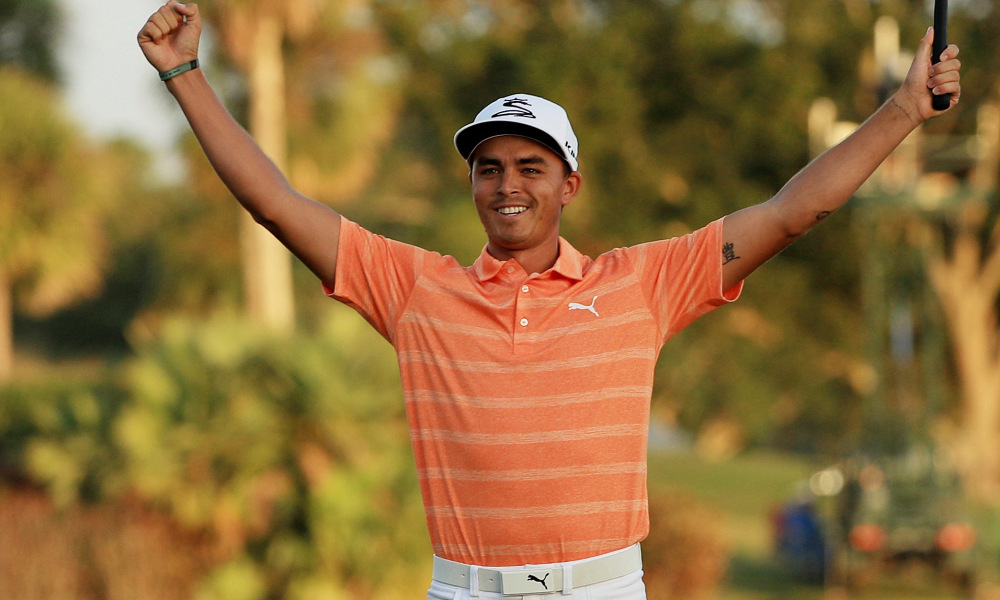
    Rickie Fowler Will Win a Major

    2018 will be Rickie’s year. I predict that he will finally win a major tournament. He finished 2017 by winning Tiger’s tournament – The Hero World Challenge – in The Bahamas against a small but very strong international field. On the PGA Tour he enjoyed career highs in Top Tens (11), Top 25s (17) and Prize Money ($6,083,197). He also had the second lowest scoring average on tour at 69.083 and led the tour in sand saves at 68.66%. he’ll be pushed hard by good buddies Jordan Spieth and Justin Thomas, but I think he’ll use their previous major victories as motivation to join the club.

    New Drivers, Prices Pushing $500

    It should not come as a shock to anyone that most of the major golf companies will have new drivers for sale in 2018. Naturally, all of them will offer more forgiveness, better control and more distance. The driver is, of course, the most oft changed club in our bag and the promise of a few more yards to gain an advantage on your playing partners is often too attractive to pass up. That’s why the bulk of marketing dollars from companies like Callaway and Taylor Made go into driver sales. While the physics of hitting a golf ball has hit a scientific wall due to limits imposed by the USGA, companies are turning to more advanced materials and adjustability to sell new drivers that can be tuned specifically for each golfer. These changes are also pushing prices higher, and we’ll see the $500 mark become pretty standard for a new driver in 2018. Sadly, it won’t help, but more on that later.

    Golf Participation Will Continue To Evolve

    According to the National Golf Foundation (NGF), the number of people who played golf on a real golf course in 2016 fell 1.2 percent from 2015 to 23.8 million. Given statistical margin for error, these participation numbers have been more or less flat for the last decade. But the way in which we are measuring golf participation is changing. The NGF is now saying that defining golf participation only as playing 18 holes on a regulation course is too limiting. Thanks to the success of facilities like Topgolf and indoor golf simulators, the NGF was able to add more than 20 million off-course “participants” to the game of golf. 8.2 million of those people never stepped foot on a golf course. Most people that go to Topgolf don’t identify as golfers, but the NGF counts them anyway. If you hit a golf ball with a golf club, to the NGF you are a golfer. However you define it, in 2016 the number of beginning golfers grew 14 percent over 2015 – an all time high. And for the first time in five years, the number of “committed golfers” also grew. If you are reading this, you are probably one of the committed crowd. However you count, it seems the game of golf is seeing increases in participation, and that’s a good thing. 

    Tiger Woods Will Get Injured Again

    Sorry Tiger fans, but you knew this was coming. He looked great at the Hero World Challenge about 3 weeks ago, but it remains to be seen how his surgically repaired back & knees will hold up. We’re talking about a professional golfer who’s had four knee surgeries, four back surgeries and injured his achilles in both legs. Twice. I believe the game of golf is better when Tiger is prowling on Sunday leaderboards, but at this point in his career I just don’t think his body will allow him to compete at the highest level for much longer. Let’s hope he has at least one good major run in him before his body fails him and he’s forced to retire, but expect him to spend some time in 2018 nursing injuries yet again.

    I’ll Break 80 as a Righty & Lefty

    I’ve played golf seriously since 1990 and I’ve managed to maintain a scratch or better handicap for almost 20 years, so obviously the first part of that prediction is a no-brainer. A plus handicap golfer like me will break 80 at least 90 percent of the time. But the second part will be much more difficult. I used to play left-handed more regularly before I moved to Florida in 1997, but since then I’ve played golf left-handed exactly twice, and it wasn’t pretty. My best round as a lefty was an 83, but that was about 25 years ago. My latest effort with a new lefty set I just scraped together last week was a confidence crushing 96, although I was very rusty and only playing with 11 clubs. I still need to find a driver, 5-wood and 3-hybrid for my lefty set. The goal of breaking 80 left-handed is quite ambitious, but I think I can do it with some practice. I’ll be chronicling this journey right here in the coming months.

    New Clubs Still Won’t Help Your Game

    That $500 driver you just bought with the fancy adjustable hosel and movable weights? You know, the one that promised more distance and forgiveness? It won’t really help your scores. Sorry to be the bearer of bad news. Even if that new driver really did give you more distance, the improvement likely won’t be noticeable, and your scores won’t improve. Why not? Because you still suck at chipping and putting, that’s why! The golf marketing machine has led you to believe that the driver is the most important club in the bag, but at best you’ll only use it for 14 shots on a regulation golf course. Despite all the advancements in technology the average golfer still shoots around 100. If that sounds like you, driver swings account for less than 15% of your score, and shots with the wedges and putter account for more than 65% of your score. That $500 is much better spent on lessons for your short game than on the shiny new driver.

    USGA vs Amateur Golfers

    I’m part of the growing number of amateur golfers that love the game and want to see if grow but are becoming frustrated with the direction the USGA is taking the game. When it comes to the rules of golf, we want to see things get simpler and help us play faster. While the USGA and PGA have given us some half-assed initiatives like “Tee it Forward” and “While We’re Young” to help the pace of play for amateurs, they continue to allow players on the professional tours to get away with 5+ hour rounds. When it comes to the rules of golf, we amateurs also keep getting the shaft. A couple of the biggest rule changes we’ve seen recently were squarely aimed at professional golfers, but didn’t really make a difference and instead have negatively impacted the amateur game.

    The groove rule change in 2010 was designed to make it harder for professionals to control the ball out of the rough, placing a premium on hitting fairways in an effort to combat the “bomb and gouge” playing style of the Tiger Woods era. It didn’t work of course, as equipment companies countered with higher lofted wedges, more precise CNC machined grooves, shafts designed specifically for wedges that produce more spin, and softer golf balls with more advanced core and cover materials that spin more. The only people that suffered with this rule change were of course amateurs. Not possessing the athletic ability or club head speed to impart spin on the ball like a pro, the wedge game became that much more difficult for the rest of us because of a rule change made with less than 1% of golfers in mind.

    The next major rule change  banned the use of anchored putters. Everyone knows at least one person who used a “broomstick” or belly putter prior to the ban. Again aimed largely at the professional tours, the USGA and R&A were scared that an anchored putting stroke was an unfair advantage over the un-anchored stroke, even though PGA Tour putting statistics didn’t support that argument. They imagined entire generations of young golfers growing up with belly putters and decided they weren’t having it, so they banned the use of any putting stroke where the club is anchored to your body. How did it work? Well, I know a guy that still uses the putter, just not anchored. He says his putting hasn’t gotten any better or worst since the ban. An other guy I know using a long putter is a tournament level golfer but quit playing USGA sanctioned events in protest. At least those touring professionals can’t take advantage of anchored strokes any more even if it hurts amateurs everywhere. So how did the anchoring ban work out anyway? Well, the two best putters on PGA Tour Champions in 2017 were Berhand Langer and Scott McCarron. What do they have in common? Yeah, you guessed it. They both use a long putter. Nice work USGA.

    I’m being pretty hard on the USGA, but it’s not all bad. In fact, the list of proposed rule changes for 2019 are very good, and I think they’ll make the game a little quicker, a little simpler and more enjoyable. It’s a good start for sure. Now, if we can just talk about making divots be treated as ground under repair…

  • BioMech AccuLock Ace Putter – First Look

    BioMech AccuLock AceIn case you were living under a rock for the past year, the arrival of 2016 ushered in the USGA’s not-so-popular ban on anchored putting strokes. What this means is that golfers can no longer lock or “anchor” the putter shaft to their bodies. The familiar broomstick long putter and belly putter styles of putting will be changed forever as everyone from PGA Tour players down to weekend hacks at the local muni are forced to adapt to the post-anchored stroke.
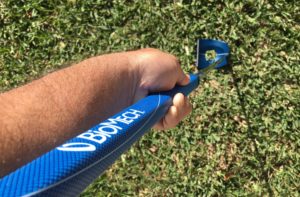
    One style of putting that stands to gain more acceptance with this rule change is the arm-lock style. You may have seen it before. Matt Kuchar has used it for several years to cash in on the PGA Tour. I spent several months playing with his unique putter a couple of years ago and wrote a review of it here. Being familiar with the arm-lock style, I was excited to see someone take the next step with this trend and make a putter specifically designed for the arm-lock method.

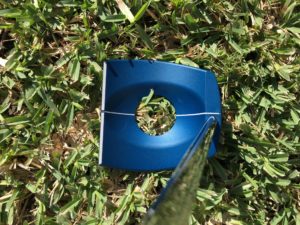
    2016-02-09 10.05.39BioMech Sports is hitting the market with their AccuLock Ace putter, and you may see some in use on the PGA Tour with Heath Slocum. During the Pebble Beach National Pro-Am you may also see some of the amateurs using the AccuLock Ace as they are being given to all the participants to try out. I spoke to the founder of BioMech – Dr. Frank Fornari about the design at the 2016 PGA Show and I’m excited to try it on the course. Stay tuned for the full review of this unique and interesting looking putter soon!
    2016-02-09 10.05.18

  • High Heat Driver – Game Changing Technology For Amateurs

    High Heat Driver – Game Changing Technology For Amateurs

    high heat soleKnuth Golf may be a new player in the golf equipment market, but the company’s namesake is anything but. Dean Knuth spent many years working with the USGA to develop and evolve the current course and slope rating system that is used to establish, maintain and adjust player handicaps different courses.

    With degrees in mathematics and computer science and decades of service to golf, Dean was the obvious choice to design the first driver that is specifically made with the amateur golfer in mind, not the pros on tour. So what does it take to design a club for amateur golfers, and how does it differ from other drivers on the market?

    The Technology

    Amateur golfers don’t swing like the pros, so why play the same driver the pros play? Knuth’s High Heat driver is designed to help slower swing speeds of amateur golfers, and it does that by offering a driver with a center of gravity (CG) that is 25% deeper and 18% lower than any on the market.

    What does a low and deep CG do? Simple. It makes the club easy to hit! The deep and low CG of the High Heat driver allows golfers with slower swing speeds to launch the ball higher with less spin than other drivers. Another benefit of the deep, low CG is forgiveness. Since most mid-to-high handicap golfers tend to hit the ball lower on the face, the low CG is a great benefit to help get the ball airborne.

    “High MOI” is technical term that golf companies are tossing around these days. MOI, or Moment of Inertia is simply a measure of resistance to twisting. What high MOI means for a golf club is more distance and better accuracy on off-center hits. The High Heat has a higher MOI than just about every driver on the market. Terms like moment of inertia and low CG sound cool for a testing lab, but in the real world what it means is you get a club that is very easy to hit solid, and very forgiving when you miss it a bit.

    Visually Stunning

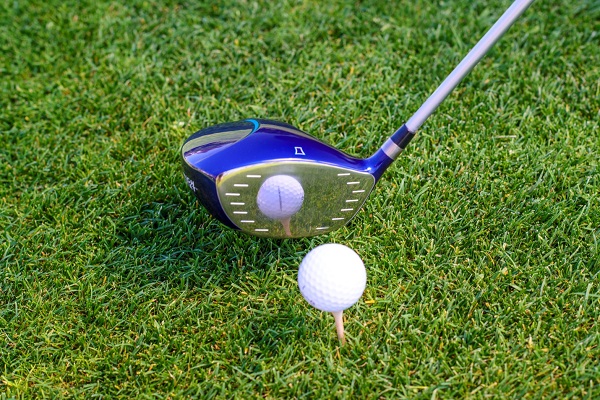
    high heat faceThe first thing you’ll notice about the High Heat driver is the sleek cobalt blue paint job and the shiny mirror face. The cobalt blue is striking and sharp, and gives the High Heat an identity that is unmistakable. The blue color scheme was also favored because it mimics the color of a flame when it burns the hottest. The polished mirror face is functional as well as being aesthetic. When hit, the ball leaves dimple marks on the face telling you where you made contact, and simply wipe away with a soft towel. Plus you can use it to deflect sunshine into your opponent’s eyes while he’s hitting! (wink)

    Specifications

    The High Heat driver comes in right and left handed models in three lofts – 9.5, 10.5 & 12 degrees. Standard length is 45 inches. There are also four premium shaft options to choose from: Fujikura Pro Sakura, Fujikura Pro 53, 63 and 73 and the Aldila Magnum 44. My testers had the Fujikura Pro 73 in X-Flex and the Fujikura Pro 63 in Stiff flex.

    Play Testing

    I spent quite a bit of time playing and testing the High Heat, and put it in as many players’ hands as I could to get as much feedback as possible. After half a dozen rounds with it I can conclude that the High Heat is one of the most playable and forgiving drivers I’ve ever seen.

    Someone like me who swings over 110 MPH and hits the sweet spot with regularity won’t see as much benefit from the High Heat as the average golfer, but even for me it was very accurate and forgiving on mishits. For the other 95% of golfers out there, this driver is a game changer. The low & deep CG really helps players with slower swing speeds launch the ball higher with less spin while still being very forgiving and playable.

    Many of the play testers that tried the High Heat said that it had a huge sweet spot and the ball seemed to shoot off the face with a springy feel. The noise was also distinctive. It sounds a bit like hitting the ball with an aluminum baseball bat. Most testers I gave it to gained distance with the High Heat, and not surprisingly the golfers with the slowest swings seemed to get the most out of it.

    In my personal testing I got great results from the High Heat, even with my tour-level swing speeds. While it is designed primarily for average golfers, any golfer can benefit from it. In my case I saw better forgiveness and excellent accuracy. The look and sound are unique, but not off-putting by any means. Personally I think the driver is gorgeous.

    Machine Testing

    hhcrownKnuth Golf saved me the trouble of inventing a golf swing robot to test their club against the other leading drivers on the market. Instead, they contracted with Golf Labs, the most reputable independent golf testing company in the world. Below is an excerpt of the results of that testing provided by Knuth Golf:
    On October 29, 2014 on a clear and relatively calm day in the San Diego area, Golf Labs tested the High Heat driver and Major Brands on its range using their precision robotic tester set at 95 mph.

    High Heat’s submission, identified as D-12 on the hosel, was marked 10.5 loft on the sole and was shafted with a Fujikura Pro 853 Stiff flex 53 gram shaft. It was tested against the Major Brands’ 10.5 lofts with their standard Stiff flex shafts. The testing was conducted against TaylorMade SLDR, Ping G30, Titleist 915 D2, Callaway Big Bertha Alpha, and Nike Covert 2.0.

    Golf Labs’ test used its standard 5 point test which provides total distance and dispersion from the center line on center and four off-center hits based on hitting six balls at each of those 5 points. The four off-center hit locations are located 1⁄2” above and below the center of each driver’s face; and 3⁄4” to the right and to left of center. Golf Labs also used new Titleist NXT golf balls.

    Golf Labs’ test results showed that High Heat’s total distance on center and off-center hits toward the center line was the longest, its total dispersion was the lowest and it had the most forgiveness than any of the Major Brands with one partial exception. The only exception was Callaway’s Big Bertha Alpha total distance toward the center line on center hits was the longest but High Heat’s total distance toward the center line for off-center hits was longer than Callaway’s Big Bertha Alpha and High Heat’s total dispersion on center and off-center hits was lower than Big Bertha Alpha.

    Final Thoughts

    The High Heat driver from Knuth Golf is a game changer. It has the lowest and deepest CG in the industry and is one of the most forgiving, easy to hit clubs I’ve ever hit. If you believe high performance can only come from a name-brand driver, you’ll be shocked when you hit this one. As soon as you hit it, I’ll bet you will want to put it in the bag. Many of Knuth’s happy customers have been prodding him for the past year or so with the inevitable question – When will you make fairway woods and hybrids? The answer is – Very soon!

    Knuth Golf introduced their new fairway woods and hybrids at the 2016 PGA Merchandise Show in Orlando, Florida, and they will be available in time for the 2016 golf season. The High Heat driver sells for $399 direct, but you don’t have to pay that much. In fact, to save $70 check out the special offer below! For more information on all the clubs available from Knuth Golf, visit their website at www.knuthgolf.com

    Special Offer

    We have arranged for a special price of $329 for the High Heat driver, which also has a 30 day full money back guarantee. Just go to www.knuthgolf.com, add the driver to your shopping cart, and at checkout simply select Intothegrain.com when asked how you heard about High Heat. Happy shopping!

  • WITB – September 2015

    WITB – September 2015

    As a golf blogger, I get to handle many different golf clubs and try many products over the course of a year. As a result, I always get asked about what’s in my bag. Most amateur golfers like me aren’t sponsored by club companies, so our bags tend to be a mix of clubs from different manufacturers.

    While I have had opportunities to officially endorse products in the past, doing so might violate the rules of amateur status as outlined by the USGA in rule 6.2, and that would be a no-no since I sometimes compete in FSGA and USGA events. Therefore, I must disclose that none of the companies shown here paid me to represent their brands.

    After years of testing hundreds of drivers, fairways, hybrids, irons, wedges, putters and assorted golf gadgets, these are the ones that have found a place in my bag as “gamers.” I’m always tinkering with and testing new clubs, but my gamers remain pretty consistent. The only part of my bag that changes constantly is the putter, because I’m a mess on the putting green and always looking for the BBD – bigger better deal.

    What’s In The Bag?

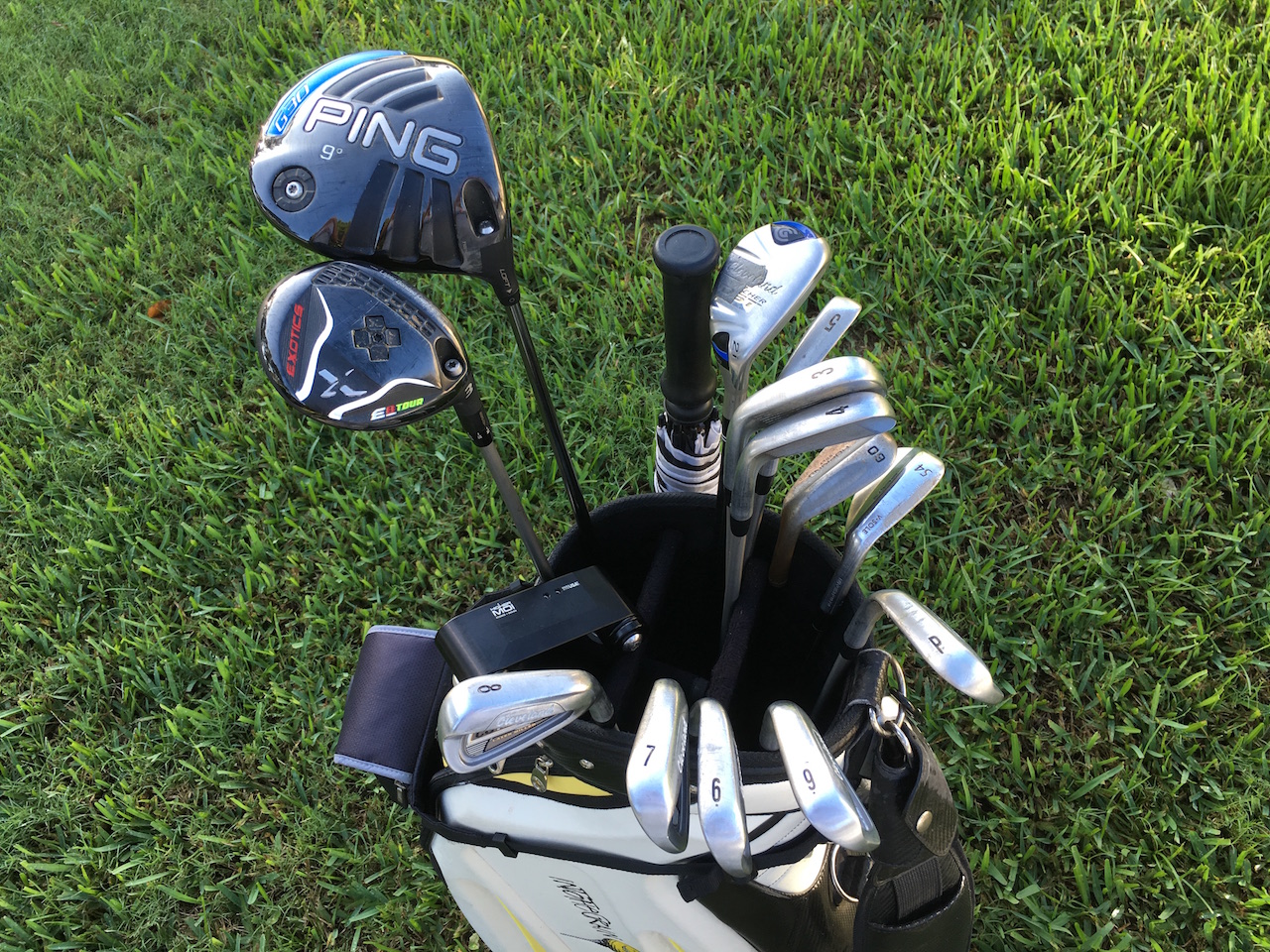
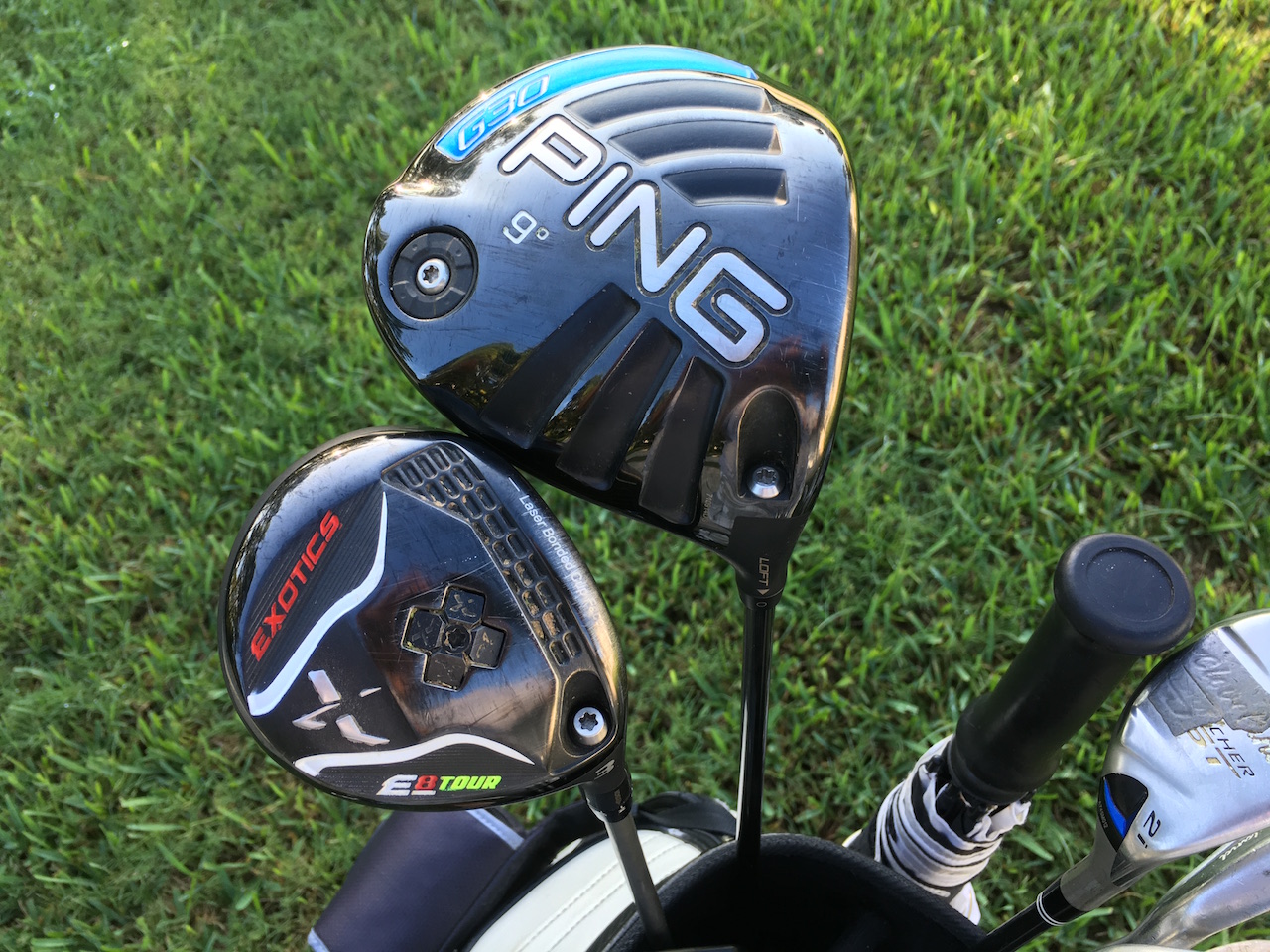
    Driver: Ping G30 (9° w/ Ping Tour 80x)
    Fairway: Tour Edge Exotics E8 Tour (14° w/ Mitsubishi Rayon Diamana S+ 70x)
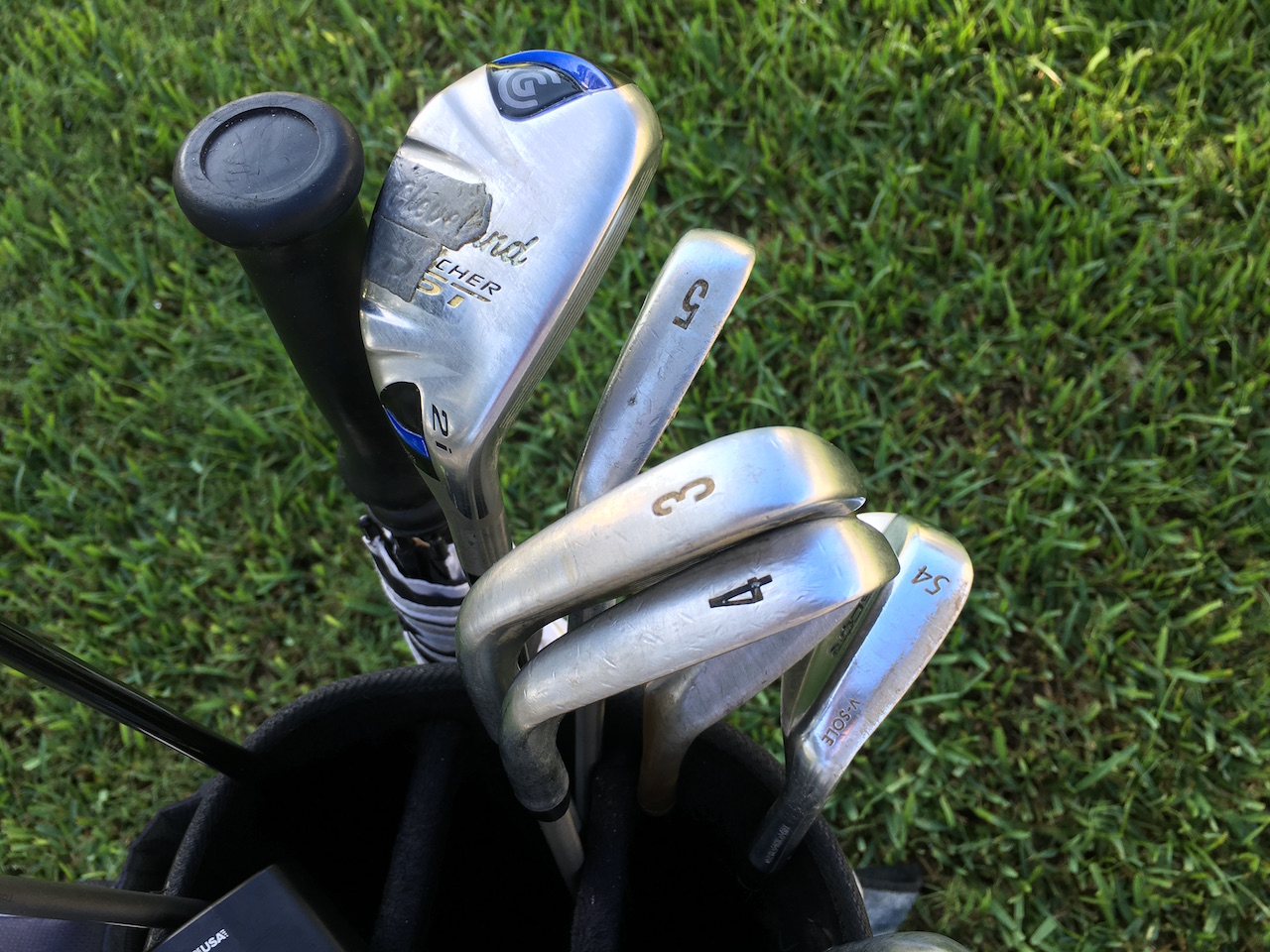
    Hybrid: Cleveland Launcher DST (18° w/ Miyazaki C.Kua 83x)
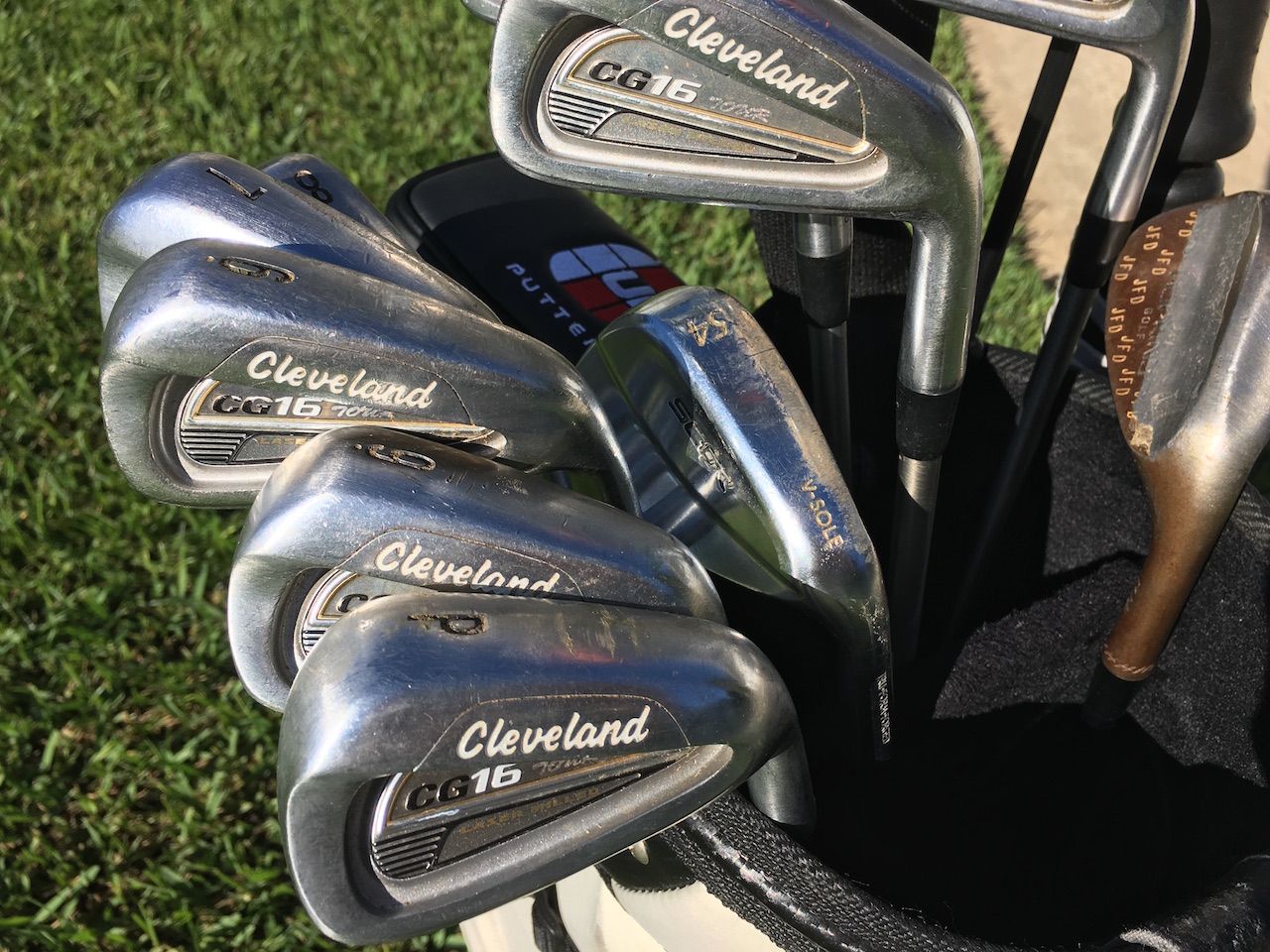
    Irons: Cleveland CG16 Tour Concept 3-PW (w/ Aerotech Steelfiber i95cw x-flex)
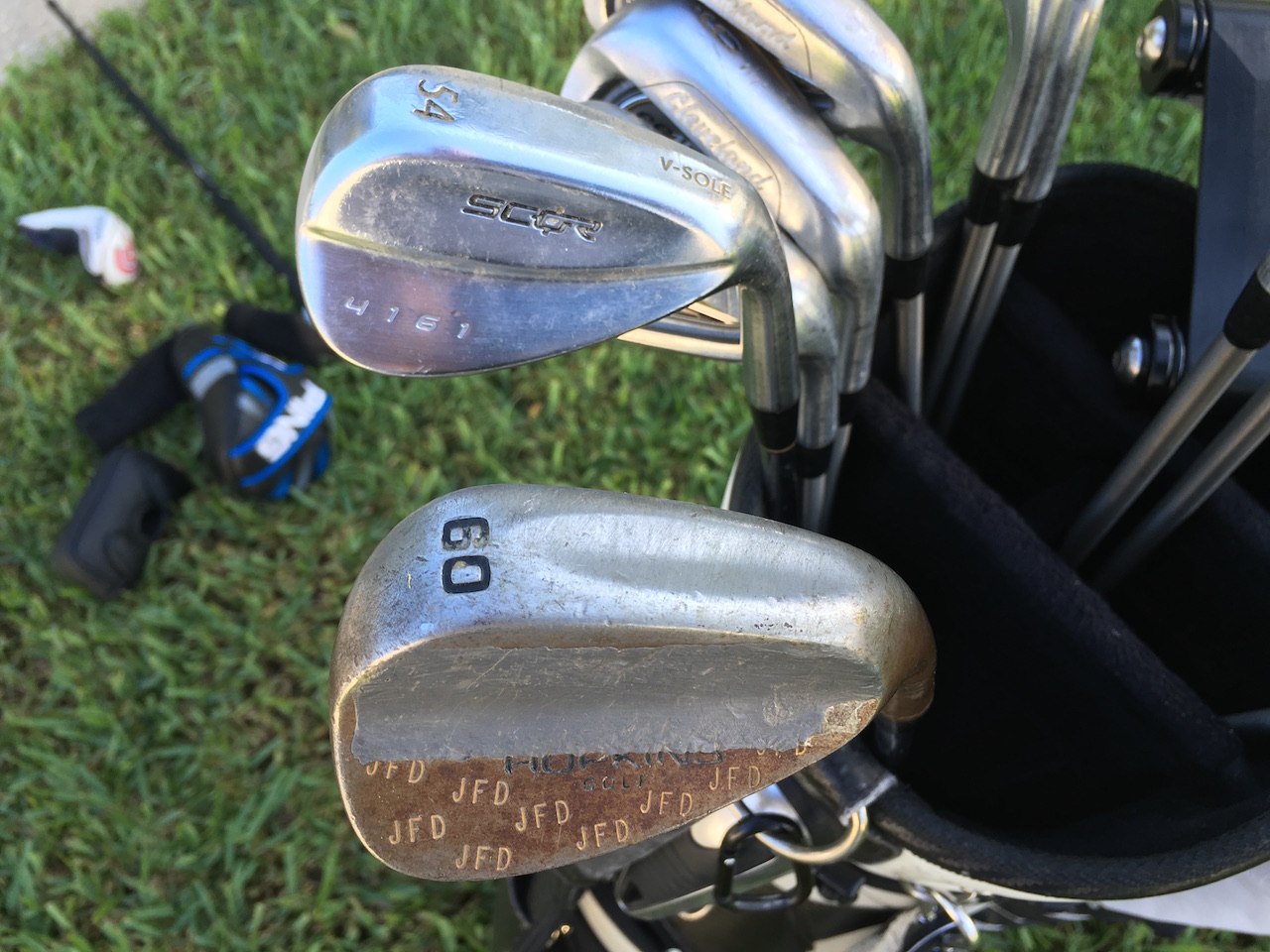
    Wedges: SCOR Golf 50° & 54° (w/ True Temper Dynamic Gold X100)
    Lob Wedge: Hopkins Golf CJ-1 60° (Custom channel grind w/ Dynamic Gold X-100)
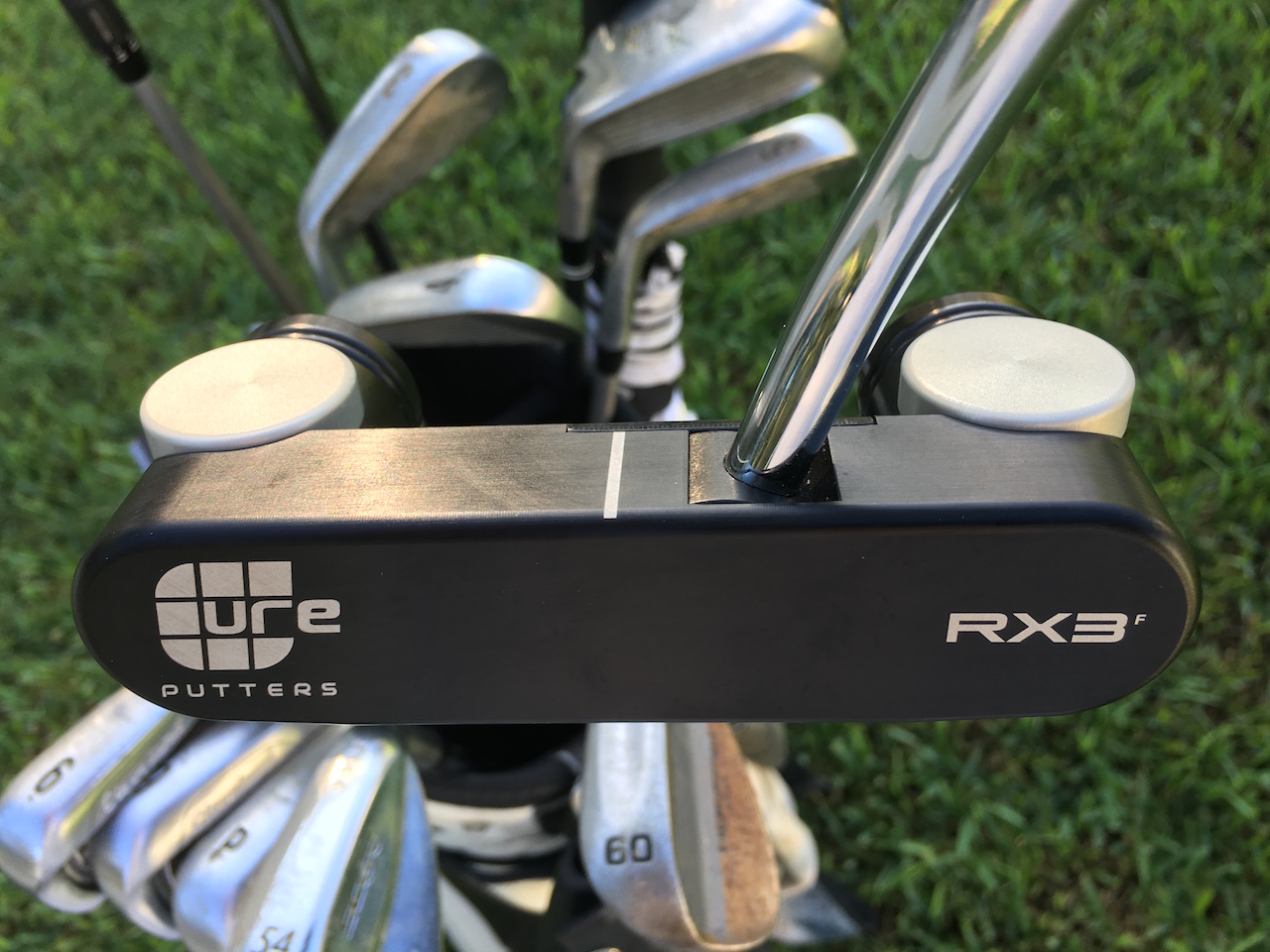
    Putter: Cure RX3F Putter
    Ball: Srixon Z-Star XV

    My current setup has been in place for over a year, except the 3-wood and putter. I recently started testing the Cure RX3F putter and after some work on the putting green and one round of golf, I decided to bring it to the WAGT National Championship at Shawnee Inn & Golf Resort. The Cure putter will be featured in a review article soon. The Exotics E8 Tour replaced my trusty old Adams RPM LP back in May. After years of searching, I finally found a fairway wood that out performed the Adams. You may notice I listed 15 clubs. That’s because I usually swap the 3-iron for the 50° gap wedge depending on the course setup where I am playing.

    WITB 09-2015

    WITB 09-2015

    WITB 09-2015

    WITB 09-2015

    WITB 09-2015

    WITB 09-2015

    Coming Soon…

    I’m long overdue for a new set of irons. The CG16 Tour Concept irons that came from Cleveland’s Tour Van have been awesome, but they are almost five years old and ready to be demoted to a backup role. The Aerotech Steelfiber i95cw shafts are amazing. I’ve said it for years – I think they are the best iron shafts you can get, and their popularity on the professional tours all around the world backs up that claim.

    I’m currently testing the Srixon Z745 irons, Z U45 3 & 4 Utilities and a Z H45 2 Hybrid. The Z745 irons are a forged cavity back club that looks sharp and performs similar to my CG16s. The clubs I’m really excited about are the Z U45 3-iron and 4-iron. They are called utilities because they have the looks and workability of an iron with the forgiveness of a hybrid. I love hitting long irons, and these things make it even easier to hit them. The Z H45 16° hybrid will fill the distance gap nicely between the 3-iron and 3-wood. I was looking for 5-10 more yards out of my hybrid and this guy will do the trick nicely. I have a strong feeling that this fantastic 2-PW set will soon be my gamers.

    Ping’s awesome G30 driver has been in my bag since last fall, but I’ve started experimenting with the G30 LS-TEC driver which is the same as the regular G30 but spins slightly less. According to Ping, 400 rpm less. Combining the LS-TEC with my switch from the softer, higher-spin Srixon Z-Star back to the lower spin and firmer feeling Z-Star XV, I should see a measurable decrease in spin off the tee which means more distance.

    The SCOR wedges I got a few years ago have been stalwarts in my bag ever since I first hit them. I started with SCOR’s complete short game system: 42°, 46°, 50°, 54° & 58°. Going from the 42 and up, they replace your traditional 9, PW, GW, SW & LW. SCOR wedges are forged and their unique v-sole design works amazingly well in all conditions. However, they have taken a real beating from heavy use and need to be replaced. Enter Ben Hogan Golf. SCOR’s founder Terry Koehler acquired the rights to Ben Hogan golf equipment and re-launched the brand with his already proven TK15 Wedges and the new Fort Worth 15 irons. The result is a gorgeous set of forged blades and wedges that perform on par with any of the best irons in golf. They are also much more forgiving and easy to hit than you might think for a blade. The TK15 wedges will soon be replacing the aging SCOR wedges in my bag.

    I love my Hopkins 60° custom grind wedge. The Channel Grind basically gives me two wedges. With the face square it has very low bounce, making it perfect for fairway shots and tight lies. With the face open it has high bounce for deep rough and sand. This wedge has made me look like a much better bunker player than I am, so it’ll be very hard to replace it. The new Callaway Mac Daddy PM Grind wedge might just do that, however. Designed with heavy input from Phil Mickelson, this wedge has grooves all the way to the edges of the face and a very high toe to help with shots from the deep rough, along with a similar channel-type grind on the sole. My early testing so far has been very promising.

    I’ll try to post another WITB early next year so we can see what’s changed and if my predictions for new gamers comes true. Until then, keep it in the short grass!

  • Leupold GX-4i2 Rangefinder

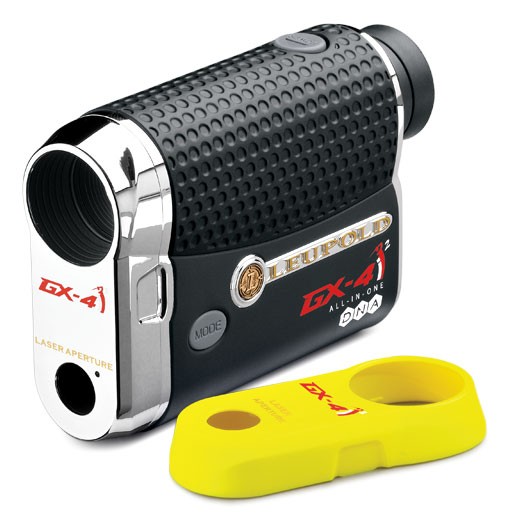
    Leupold GX-4i2 RangefinderWhat do guns and golf have in common? The technology in many of the best rangefinders used on the golf course comes from rifle scopes and range finders made for hunting and military use. The latest offering from optics company Leupold has taken golf rangefinder technology to the limit with its new model – The GX-4i2 Rangefinder.

    The GX-4i2 Rangefinder is light, compact and well made. Leopold’s Smart Key technology now conforms to USGA Rule 14-3 concerning distance measuring devices. It also features an improved PinHunter 2 Laser and a bright, vivid OLED display. Add to that some proprietary features such as True Golf Range (TGR) and Club Selector and you have a virtual caddy in your pocket.

    The GX-4i2 can be tailored to your own personal ball-striking abilities, or used for tournament play when permitted by local rules simply by switching out the smart key plate. The silver chrome faceplate disables the TGR and slope features to make it simply measure distance, making it legal for tournament play according to USGA and R&A rules.

    However, the real fun starts when you install the yellow plastic smart key. The mini-USB key enables all the cool wiz-bang features for use in casual golf or tournament practice rounds. True Golf Range is a set of algorithms that help the user select the correct club for each shot. To use it, you input the current temperature, altitude you are at and how far you typically hit your 4, 6 and 8 irons. Once your data has been entered, the GX-4i2 measures distance and slope, then recommends the right club to hit. So far in my testing, the GX-4i2 has been very accurate in selecting the proper club. Of course there are variables it can’t take into account that affect distance – like wind, course conditions and other intangibles such as player confidence and adrenaline, but for the most part it has been very accurate on the relatively flat courses here in Florida. I would love to test it further in the mountains where courses have more slope and altitude is a factor. I would send it over to my friend Tony from Hooked on Golf Blog in Utah for some high altitude testing, but I’m afraid I wouldn’t get it back!

    The Leupold GX-4i2 isn’t cheap at an MSRP of $599, but you get a very high quality rangefinder that can be used for tournament play or casual golf with the TGR feature enabled. It measures distance in yards or meters, works even in foggy conditions and is waterproof in case it rains. The optics are top notch, very clear and red OLED display is very bright and easy to read in all lighting conditions. The device is very light and compact, making it very simple to use. Leopold crafted the GX-4i2 from aircraft grade aluminum to ensure that it will last. The only concern came from some of my older friends that had trouble keeping it steady enough to capture the pin. If the flag stick has a reflective prism installed, the GX-4i2 will lock in on it very quick. Without a prism it may take a few shots to get it right. In terms of accuracy, the GX-4i2 is probably the best on the market. Leopold claims accuracy down to 6 inches at up to 800 yards off a reflective surface, and 450 yards off a pin.

    If you are willing to shell out 600 bucks for premium quality optics, precision laser accuracy and class leading technology all wrapped in a solid, compact package, the Leopold GX-412 is the model for you. Simply put, it’s the best golf rangefinder I’ve ever used.

    )


  • Tiger Woods – Illegal Drop on 15 at the Masters?

    TigerTakesADropSo far the 2013 Masters Tournament has had plenty of good stories, like 14 year-old Guan Tianlang making the cut or 53 year-old Fred Couples in contention again, but the big story so far this morning is the controversy brewing over the drop Tiger Woods took on the 15th hole yesterday.

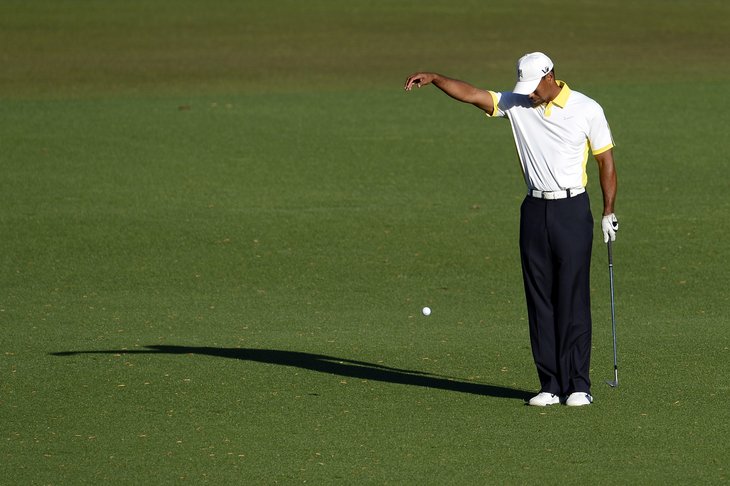
    Woods’ third shot on the 15th hole from 87 yards hit the flagstick and bounced into the water hazzard. After weighing his options, he dropped a ball back in the fairway and hit his 5th shot to three feet and made the putt for a six. Or so we thought…

    After his round, he was asked about the 15th hole during a post-round interview and he may have incriminated himself. “I went back to where I played it from, but went two yards further back and I tried to take two yards off the shot of what I felt I hit, and that should land me short of the flag and not have it either hit the flag or skip over the back. I felt that was going to be the right decision to take off four (yards) right there. And I did. It worked out perfectly.”

    Whoops! Let’s take a look at the rule in question (26-1) under which he took the drop shall we? (via USGA website)

    If a ball is found in a water hazard or if it is known or virtually certain that a ball that has not been found is in the water hazard (whether the ball lies in water or not), the player may under penalty of one stroke:

    a. Proceed under the stroke and distance provision of Rule 27-1 by playing a ball as nearly as possible at the spot from which the original ball was last played (see Rule 20-5); or

    b. Drop a ball behind the water hazard, keeping the point at which the original ball last crossed the margin of the water hazard directly between the hole and the spot on which the ball is dropped, with no limit to how far behind the water hazard the ball may be dropped; or

    c. As additional options available only if the ball last crossed the margin of alateral water hazard, drop a ball outside the water hazard within two club-lengths of and not nearer the hole than (i) the point where the original ball last crossed the margin of the water hazard or (ii) a point on the opposite margin of the water hazard equidistant from the hole.

    The text in bold is what we’re interested in here. Tiger stated he dropped his ball 2 yards back from the original spot which, by definition, is not nearly as possible to the spot from which the original ball was last played. This is a pretty clear cut situation to me, and if you follow the letter of the rules there should be no other outcome that the obvious one. He should have been assessed a shot penalty. Instead of a 6, he should have made a 7. He signed an incorrect scorecard.

    Tiger should be disqualified.

    UPDATE 09:41am 4/13/2013: Augusta National has given Tiger Woods a 2 shot penalty but he has not been disqualified. Under Rule 33-7, Augusta National decided to give Tiger a 2 stroke penalty rather than disqualify him. The rule is below:

    33-7. Disqualification Penalty; Committee Discretion

    A penalty of disqualification may in exceptional individual cases be waived, modified or imposed if the Committee considers such action warranted.

    Any penalty less than disqualification must not be waived or modified.

    If a Committee considers that a player is guilty of a serious breach of etiquette, it may impose a penalty of disqualification under this Rule.

    Don’t forget to “LIKE” the Facebook fan page for daily updates, exclusive content, unboxing pictures and more! Get involved in which products we review, win free stuff and tell us what you think!

  • Square Groove Drama – Phil Mickelson Accused of Cheating!

    Photo: Denis Poroy

    As most golf fans are aware, on Jan 1, 2010 a new condition of competition went into effect on the PGA Tour that mandated a change in the shape and volume of grooves on clubs having more than 25 degrees of loft. This new groove rule has caused outrage and much discussion for several months now. The golf club manufacturers have spent millions of dollars re-tooling their equipment to make the new grooves and meet the demand by their staff professionals to test and adopt the new clubs.

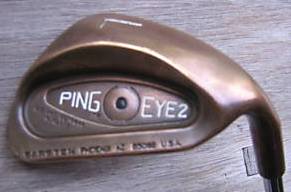
    The biggest opponent of the new rule on the PGA Tour has been Phil Mickelson, who has repeatedly bashed the rule changes and defended the position of the clubmakers. Last week, Golf Digest reported that Phil Mickelson was at Callaway Golf’s Carlsbad California testing center prepping a new set of irons, and experimenting with a few 20 year old Ping Eye2 wedges, which have square grooves. These wedges if manufactured now would be non-conforming, but because of a lawsuit between Ping and the USGA that was settled in 1990, any Ping Eye2 made before April 1, 1990 was grandfathered in and remains approved for play. The lawsuit takes precedence over any rule change.

    Ping Eye 2 LW
    Ping Eye 2 LW

    Phil Mickelson isn’t the only player who has taken advantage of this loophole in the new rule. In fact, he got the idea after reading that Dean Wilson and John Daly had put the old clubs in their bags for the Sony Open in Hawaii. Since then, more players have gone back to the older wedges in search of more spin from the rough.

    This week at Torrey Pines in San Diego, PGA Tour veteran Scott McCarron said using the old wedges was cheating, and he claimed he was appalled that Phil had put it into play. In a sport that is known as a gentleman’s game , accusing someone of cheating is a serious matter. However, Mickelson took the high road with his response, instead turning the blame squarely back on the USGA by saying “It’s a terrible rule. To change something that has this kind of loophole is nuts,” Mickelson said. “But it’s not up to me or any other player to interpret what the rule is or the spirit of the rule. I understand black and white. And I think that myself or any other player is allowed to play those clubs because they’re approved — end of story.”

    McCarron defended his comments by explaining that he was not singling out Phil for cheating, but rather every player that put one of the old wedges into play because he through it was violating the spirit of the rule. That the USGA and PGA Tour didn’t anticipate this rub is interesting. McCarron said the issue would likely be brought up at a Players Advisory Counsil meeting next week, of which McCarron is a part of.

    <

    p style=”text-align: center;”> Mickelson made no apologies however. He said he submitted wedges to the USGA that met the new requirements, yet they were not approved. Conversely, The Eye2 wedge is approved but does not conform under the new rules. He also said testing procedures are different in the United States and overseas, adding to the frustration. "This whole groove thing has turned into a debacle," Mickelson said. Mickelson said he wasn't sure if he would continue to play the Ping wedge, because he didn't find much difference in spin from that and the regulation grooves in his other Callaway wedges. "There's a good chance I'll switch back, but not for the reason that I feel like I've been doing something wrong," Mickelson said. "I think that any player using these clubs that are approved under the rules of golf are fine." The PGA Tour has the ability to make a local rule which would outlaw the use of those wedges stemming from a 1993 settlement with Ping containing different conditions, but the Tour has yet to make any ruling in the matter. Phil Mickelson is currently a few shots from the lead. Scott McCarron missed the cut.

    Want to win free stuff? Subscribe to our email updates! You'll get the latest fresh news, reviews and stories delivered right to your inbox or RSS reader, and automatically be entered in our latest contests and giveaways! Also, don't forget to check in with our Facebook fan page for exclusive content and get involved by leaving us comments on what you think!

  • TaylorMade Introduces TP xFT Wedge

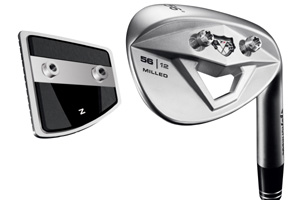
    xFTWedge_34_prI received the latest press release from TMAG this week about the new TP xFT wedges, and I thought I would share it with everyone. A review is coming very soon so you can make a more educated choice as a consumer! Thanks for reading!
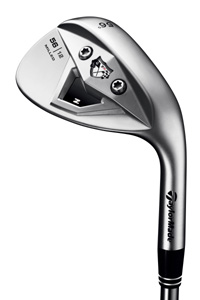
    Carlsbad, Calif. (November 16, 2009) – TaylorMade Golf has introduced the TP wedge with xFT (Exchangeable Face Technology), which allows players to easily remove a worn clubface and replace it with a new one to maintain peak performance in terms of spin and control.

    “Though the face of a typical iron is sturdy, it isn’t impervious to wear,” said Bret Wahl, senior director of iron, wedge and putter development. “A wedge’s face wears from contact with the ball and from the dirt and sand that’s often sandwiched between the ball and the face at impact. Every time you explode from sand with your wedge it’s like rubbing a piece of sand paper on your clubface. Over time the face wears down and the edge-radius of the grooves becomes dull. In addition to the normal wear and tear a face suffers from normal play, it can be nicked and damaged in a variety of other ways such as when clubheads bang together when you put your bag down or when you walk or drive your cart, or when you hit out of waste areas, or when you unintentionally scrape the clubface against debris when hitting the ball from poor lies off the fairway.”

    <

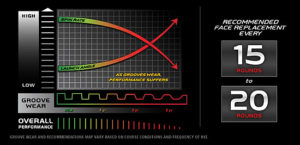
    p style=”text-align: center;”> The negative effect is three-fold: 1) The groove's edges lose the ability to grab the cover, reducing spin. 2) The groove loses volume into which moisture and debris once were channeled. Less groove volume means that more substances will come between the ball and the clubface, further reducing the amount of spin that can be imparted, especially from the rough. 3) The texture on the surface of the face (from milling or sandblasting) is reduced, which limits the face's grip on the ball. How quickly does the face of the average wedge show signs of wear? TaylorMade studies indicate that after about 1,000 shots the edge-radius of each individual groove changes and the roughness of the face surface is worn away. For players who play with reasonable frequency, 1,000 shots add up pretty quickly; they add up even faster for players who practice between rounds.

    Tour Pros and "Fresh Grooves"

    Tour pros are exceptionally mindful of the importance of wear on their wedges, and because of that they replace them frequently to get "fresh grooves" and a rough face surface for the maximum spin they deliver. Certain pros, including those in the top-tier, put new wedges in play every week, while some players change every three or four tournaments. Two members of the TaylorMade Tour Staff, Dustin Johnson and Jason Day, ask for a new 60° wedge every month. Other tour pros trade out at least three or four times per year. xFTWedge_assembly_pr One popular reason why many pros don't retire their wedges more often is because they've become accustomed to the club's look, weight, feel and sole grind, which influences the way the sole reacts with turf, rough and sand. And sometimes they have great confidence in a particular wedge that they've performed well with under pressure. Yes, such pros would like fresh grooves, but they don't want to give up the wedge they've become attached to. Occasionally you see a pro with a wedge so well-used that the lower-middle part of the face is worn almost smooth; a clear case of sentimentality keeping the club in the bag. Meanwhile, myriad amateurs would like to put new grooves in play with greater frequency, but can't justify the expense of buying new wedges once or more per year.
    xFT: Keep the Clubhead, Exchange the Clubface

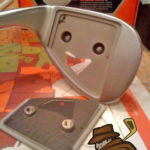
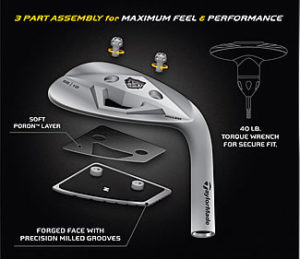
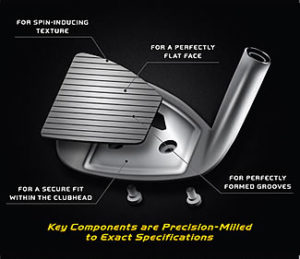
    xFT is a simple, cost-effective way to give tour pros and amateurs fresh grooves while allowing them to keep the same clubhead. Our new Exchangeable Face Technology (xFT), which is incorporated into our newest TP wedge design, allows you to quickly and easily exchange an old, worn wedge face with a brand new one. The xFT face is held in place with two screws located on the back of the clubhead that can be loosened and tightened with a white R9 torque wrench. Simply loosen the xFT screws to remove the old face and tighten the screws to lock in the new, fresh face. Each xFT face is backed with a thin layer of Poron®, which is a soft, urethane, microcellular foam to facilitate a tight fit within the clubhead and to cushion the face from metal-on-metal contact, and which also promotes superior feel. The clubhead and particularly the wedge face and the pocket the face fits into are precision-milled to fit snugly and securely together. The tolerances in terms of length, width and depth have to be extremely tight to ensure a tight fit, so that the TP xFT wedge feels the same, sounds the same and performs the same as a traditional one-piece clubhead. xFTWedge_exp_pr Each TP xFT wedge face is forged from soft 304 stainless steel, then completed with a four-step CNC precision-milling process. First, the surface of the face is milled flat. Second, the back and perimeter of the face are machined to ensure a precise fit into the pocket in the clubhead. Third, texture is milled onto the face surface. Fourth, the grooves are milled into the face with care taken to ensure that the depth, shape and edges are perfect. xFTWedge_milling_pr TP xFT Wedge and the USGA Rules Change on Grooves Two types of xFT wedge faces will be available for purchase, either with our new ZTP groove design that conforms to the USGA's new rules change, or with our current Z groove that conforms to the pre-2010 rule on groove design. (Older groove designs will be disallowed in high-level professional competitions starting January 1, 2010 by ruling of the USGA. However, recreational golfers aren't required to adhere to the groove-change rule until 2024). In 2011 and beyond, xFT wedge faces will incorporate only grooves that adhere to the new USGA rule, such as the ZTP groove. "In a nutshell, the rules change stipulates that new groove designs must have less cross-sectional area and their edges must be less sharp," says Wahl. "Most players won't experience a dramatic reduction in spin from dry fairway lies, but will see a decrease in spin by up to 50% from the rough. All the more reason to keep the clubface of your wedge fresh and at peak performance. Our new ZTP groove is the most aggressive, spin-inducing design we have that conforms to the new USGA rule."
    [TaylorMade Golf Accessories (10% Off with Promo: TM10)]

    Each TP xFT wedge head is fashioned in a classically beautiful teardrop shape made of stainless steel and milled for precision, including the pocket into which the clubface fits. The clubhead is plated in nickel-chrome for durability, then given a beautiful pearl finish to reduce glare. Availability in stores and online will begin December 1st with the 56° loft and 12° bounce only, with nine more combinations to follow in mid-February, 2010 -- 50.09, 52.11, 54.12, 56.16, 58.09, 58.12, 60.06, 60.10, 64.06. The 58.12 and 60.10 both incorporate TaylorMade's new C-grind sole, which was developed by our tour technicians and which is highly praised by tour pros for the multitude of greenside shots it permits you to play. xFTWedge_groovewear_pr TP xFT wedges are equipped with KBS High-Rev shafts, which are slightly heavier and feature a slightly longer tip parallel region compared to other wedge shafts. KBS' data indicates that the High-Rev shaft promotes increased spin because of its weighting, its kick and the way it presents the head to the ball. The High-Rev is new, making us the first brand to use it. We expect it to be played on tour, especially since the change in the groove rule will have players anxious to find ways to keep their spin-rates as high as possible. Because the shaft's unique design promotes additional spin, we expect the TP xFT wedge to gain wide acceptance on the PGA Tour. Each TP xFT wedge will sell at a street price of $129 per club and will come equipped with a Z groove face (conforming to the pre-2010 USGA rule). Individual xFT wedge faces with either the Z groove or ZTP groove (conforming to the new 2010 USGA rule) will be sold separately at a street price of $39.
    Want to win free stuff? Subscribe to our email updates! You'll get the latest fresh news, reviews and stories delivered right to your inbox or RSS reader, and automatically be entered in our latest contests and giveaways! Also, don't forget to check in with our Facebook fan page for exclusive content and get involved by leaving us comments on what you think!

  • New Cleveland CG15 Wedges – Coming Soon!

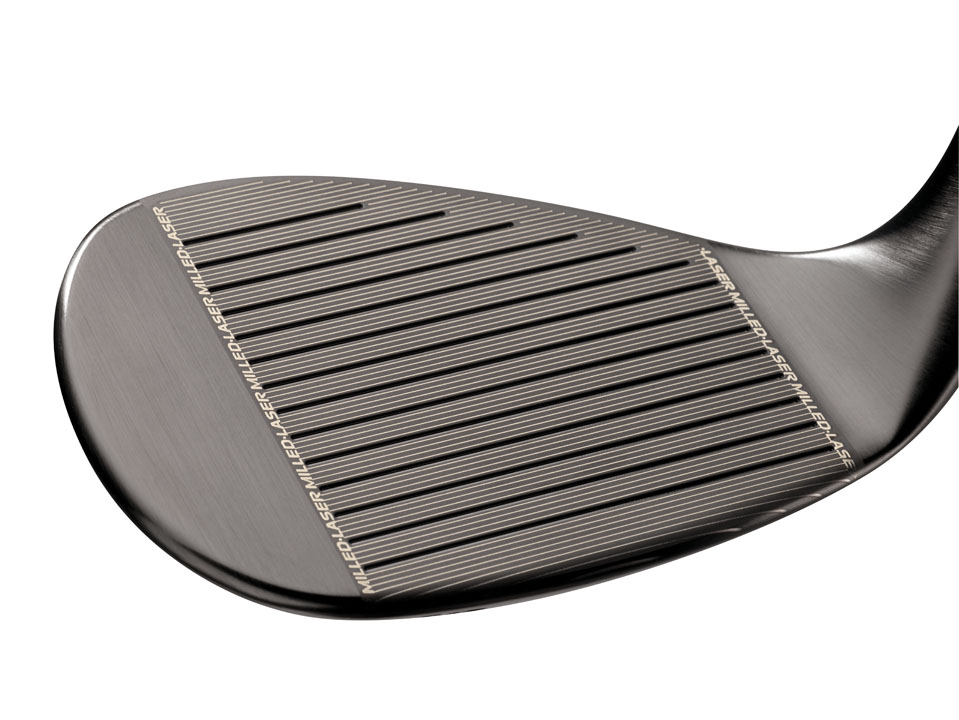
    Cleveland CG15 w/ Laser Etched Grooves
    Cleveland CG15 w/ Laser Etched Grooves

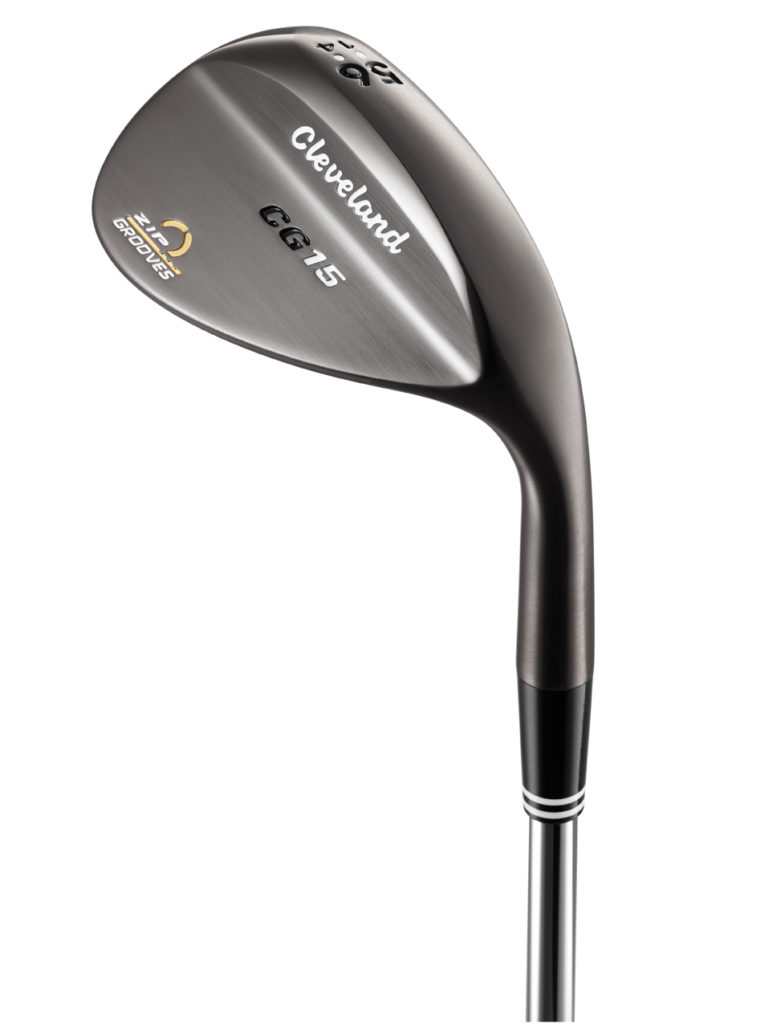
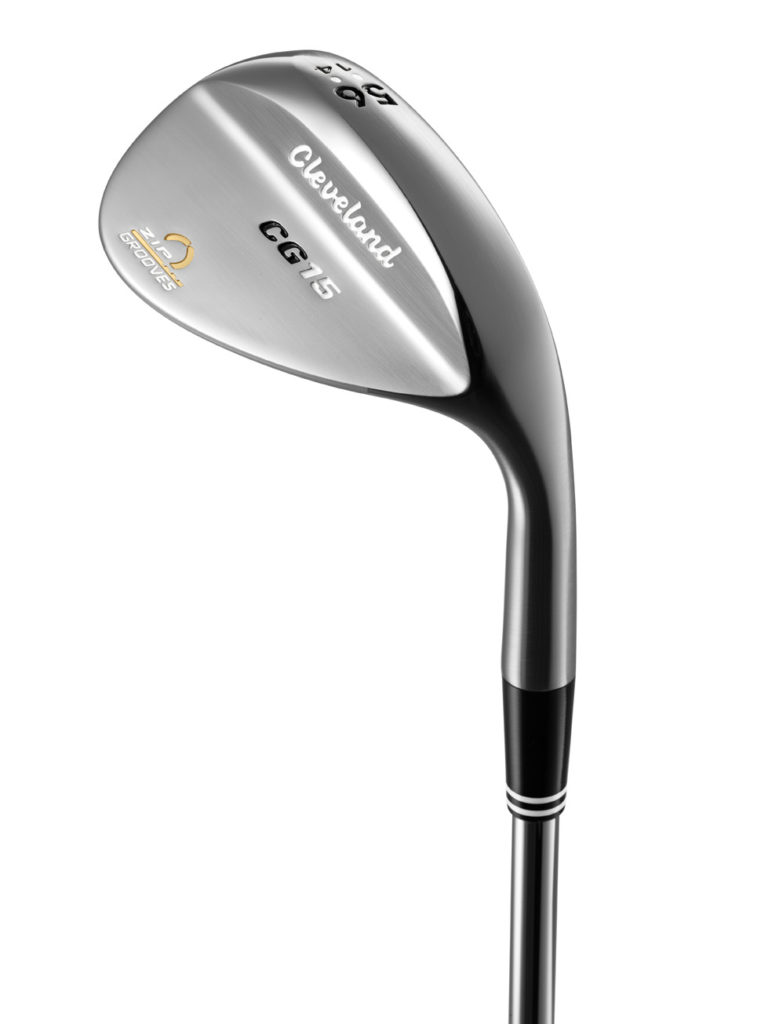
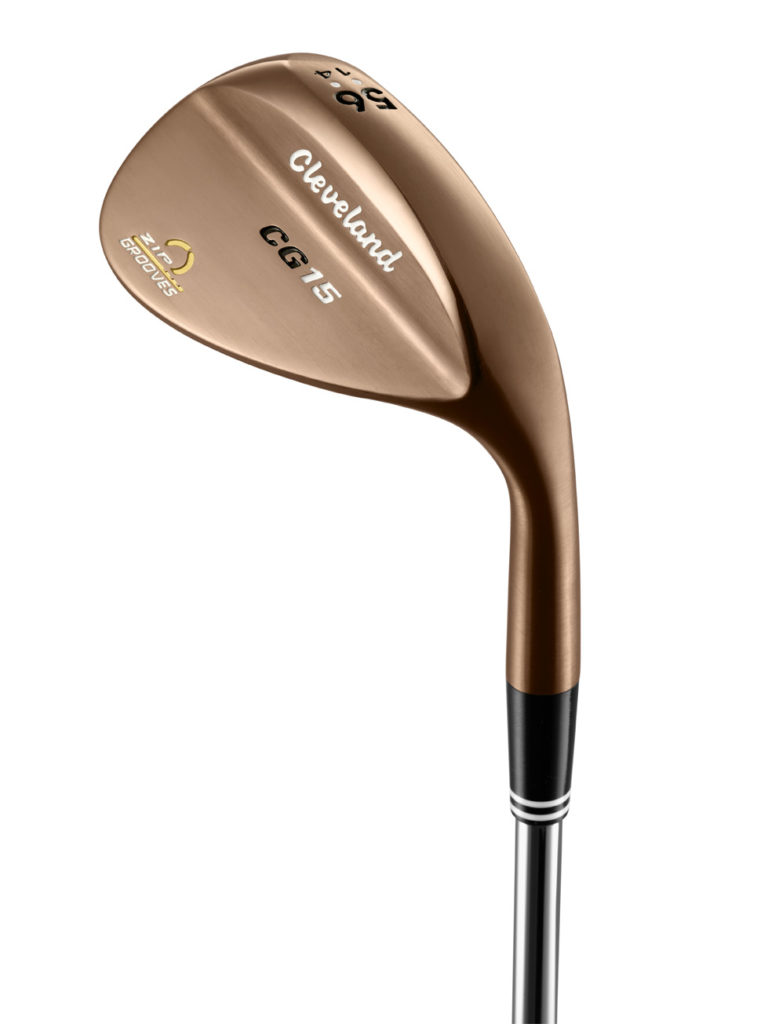
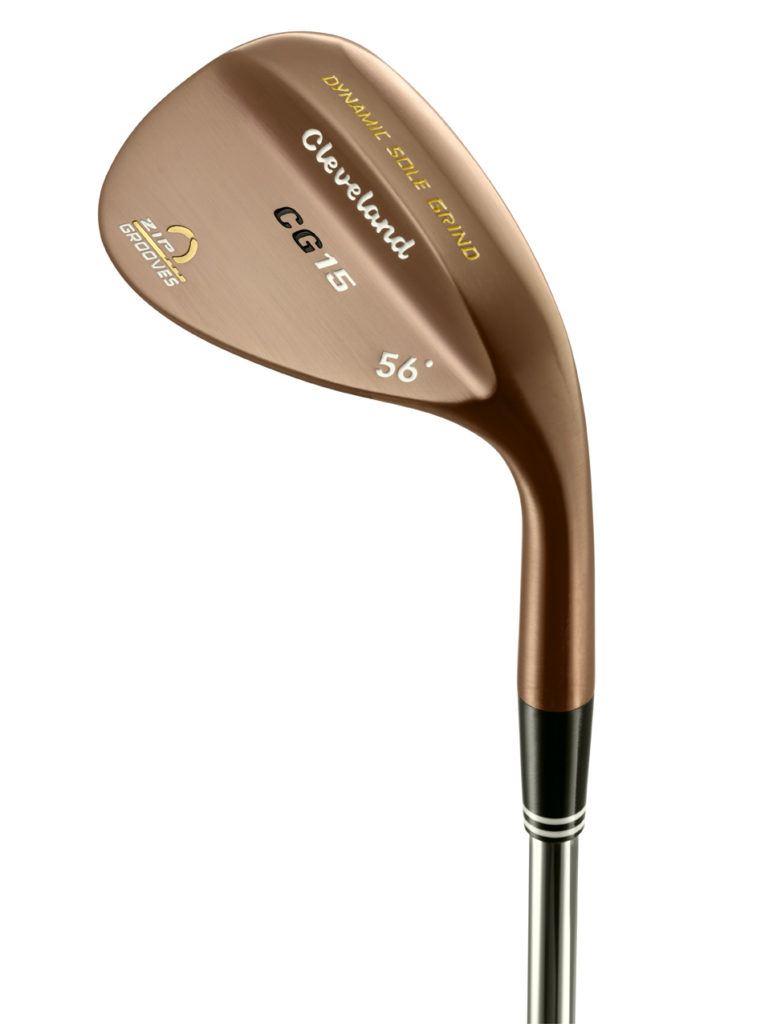
    Cleveland Golf is introducing their new CG15 wedge, which will be launched November 13th. Cleveland was purchased by Srixon earlier this year, but there doesn’t seem to be any melding of technology between the two companies. Cleveland’s current wedge choices include the CG14 which is a cast cavity style wedge, and the CG12 which looks like a more traditional wedge. The New CG15 looks a lot like the current CG12 from the back, with one exception: The dots that used to denote the bounce of the club used to be on the hosel and now are on the sole of the club, along with the bounce measurement. The CG12s don’t tell you what the bounce angle is, you would have to look it up. The new wedges will be available in 4 finishes. Black Pearl, Chrome, and Oil Quenched, with the latter coming in a DSG or regular sole grind. The will retail for $119 each.

    The other new feature of the wedges are the new laser etched grooves. Between the already spin happy Cleveland Zip Grooves are laser etched mini-grooves, designed to create even more spin. Using the precision of a laser, 4 perfectly calibrated texture lines are milled between each groove exactly to the conforming roughness limit. This roughness application optimizes ball-to-face friction and maximizes spin under the rules of golf

    In other words, you’re gonna spin these babies! Either way, if you are a casual golfer and want to take advantage of the current groove technology for the foreseeable future, I suggest you start stockpiling wedges like NRA members do Guns after a Democrat victory.

    Enjoy the pictures, and CLICK HERE for the first review of these new wedges – before they come out in stores!


    Cleveland CG15 w/ Black Pearl Finish
    Cleveland CG15 w/ Black Pearl Finish

    Cleveland CG15 w/ Laser Etched Grooves
    Cleveland CG15 w/ Laser Etched Grooves

    Cleveland CG15 w/ Chrome Finish
    Cleveland CG15 w/ Chrome Finish

    Cleveland CG15 w/ Oil Quenched Finish
    Cleveland CG15 w/ Oil Quenched Finish

    Cleveland CG15 DSG w/ Oil Quenched Finish
    Cleveland CG15 DSG w/ Oil Quenched Finish

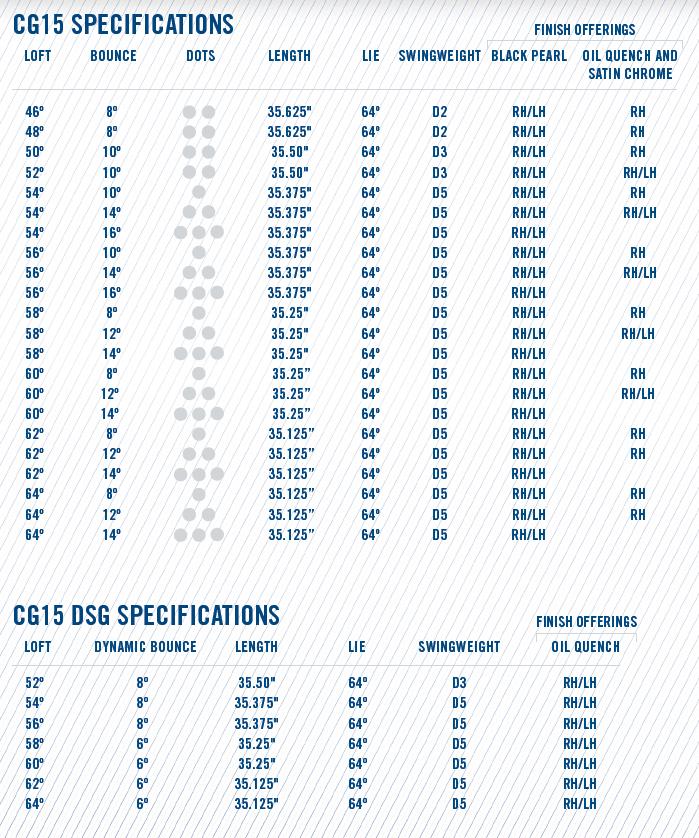
    One of the things that has made Cleveland wedges so popular over the years is there diverse selection of lofts and bounce angles, making it possible to fit just about any player to the right wedge. My only gripe is that there isn’t enough effort put into fitting wedges properly. The wedge fitting on the Cleveland Golf Website tries, but it’s more of a novelty to me. I would love to see a comprehensive wedge fitting system to match a two, three or four wedge system to the proper loft and bounce for players of all abilities, but I’ll go into this a bit more in my review of the CG15s. For now, here’s the spec sheet:
    CG15_spec_chart
    Just a quick explanation of the dot system Cleveland uses for the bounce angles on their wedges. Since most golfers don’t really know how bounce affects their wedges, Cleveland dumbed down it’s specs by using dots on the hosel instead of the actual bounce number. With the new CG15s, they have added the actual bounce number along with the dots to the sole of the wedge. Below is a simple explanation of how it works:

    Low Bounce –  1 dot

    Good when playing from firm turf conditions and tight lies.Also, fits players with shallow attack angles.


    Standard bounce – 2 dot

    Accommodates the largest variety of sand, turf and swing types.


    High bounce – 3 dot

    Excellent from softer turf conditions and bunkers. Good for players with very steep attack angles.

    <

    p style=”text-align: center;”>

    Want to win free stuff? Subscribe to our email updates! You'll get the latest fresh news, reviews and stories delivered right to your inbox or RSS reader, and automatically be entered in our latest contests and giveaways! Also, don't forget to check in with our Facebook fan page for exclusive content and get involved by leaving us comments on what you think!

  • Taylor Made XFT Wedges – Spied!

    Taylor Made XFT Wedge
    Taylor Made XFT Wedge

    The crack equipment investigators over at Mygolfspy.com have uncovered Taylor Made’s new XFT wedges, which have interchangable faces. Check out their full article about them here:

    http://www.mygolfspy.com/taylormade-xft-wedge-2010/

    View the updated story about the official intro of these wedges here!

    The concept is to allow players to replace the face of a wedge when it wears out, or for a different level of playability. Most golfers don’t get new wedges that often – maybe once a season or less, but many of the guys on tour get new wedges every week to maintain that new wedge bite. A wedge with interchangable faces would allow the player to simply change the face to bring the wedge back to like-new playability. For amateurs who aren’t affected as quickly by the new USGA Groove Rule, they could switch back and forth between conforming grooves and non-conforming grooves, depending on whether they are playing in a USGA event that requireds the new grooves or not.

    Photo courtesy of golftoimpress.com
    Photo courtesy of golftoimpress.com

    We’ll see if these wedges, when released,  catch on with the public or not. I for one am not a huge fan of this design, mostly because I’m a traditionalist and I think I would tinker too much. I also question the durability of the wedges and the mechanism for keeping the faces secure on the club through impact. Go over to www.mygolfspy.com to read the full article, and subscribe to their RSS feed, they are on the cutting edge of new equipment and it’s worth a read for sure!

    What do you think of these new wedges? Will it catch on or be a fad that goes the way of the Carbite wedge or interchangable face putters? Let us know by leaving a commment.

  • About the USGA Groove Rule Change

    Photo courtesy golfdigest.com
    Photo courtesy golfdigest.com

    It seems that the USGA, golf’s governing body in the United States since 1894, has decided that players on the PGA Tour are able to generate too much backspin from shots out of the rough. They have decided to change the rule to limit the effect of grooves to produce backspin. Of course, it’s not quite that simple. You see, the rule applies only to certain players, certain clubs, and there is much misinformation out there about what is really going on with this rule, so I thought it would be good to set the record straight.

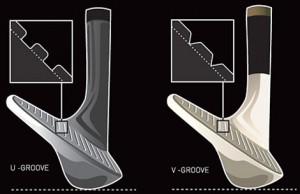
    Before 1984, all golf clubs had what we now refer to as V grooves. As it implies, the grooves on the face of the club were shaped like a V, with an angle of less than 90 degrees. In mid 1984, Ping introduced the second version of the Eye2 irons featuring U grooves following a very public battle with the USGA to allow them. The next year, they designed the square groove. I bet you thought a square groove was the same as a U groove didn’t you? The design was the same, but the difference was that they modified the grooves to create a slight radius at the top of the groove. This change reduced the amount of surface area between the groove, but didn’t change the distance between the inside edges of the grooves.

    Fast forward to 2009, and the USGA is finally pulling the trigger on a rule change related to square grooves, or U grooves, or box grooves. One of the biggest misconceptions about this rule change is that the USGA is banning square grooves. This is not the case at all. In fact, it doesn’t govern what shape the grooves can be any more than the current rule that has been in effect since 1984. Club companies can continue to make U or square grooved clubs. The new rule, as it it currently written, calls for a club’s grooves to be straight and parallel, have a symmetrical cross section and must have sides which do not converge. Also, the spacing and width of the grooves must be consistent across the face.

    The new rule actually changes the way club faces and grooves must be manufactured in three ways: One - because square grooves can channel away more grass and moisture, they now must be placed further apart on the face than previously. Two – The milling process many manufacturers use now creates a very precise and sharp edge. In an effort to dull those edges, a new measurement has been added to the rule which calls for a minimum radius of .010” on the groove. This effectively rounds off the corner of the groove edge, in theory producing less bite on the ball. Three – It allows for a condition of competition, which means that the implementation and subsequent enforcement of the rule is up to the tournament committee. It also states that the rule will only be applied to tournaments or competitions involving expert players. In other words, the rule will only go into effect on the PGA Tour, USGA, and other high level competitions. Those are the facts about the rule. We know the PGA Tour has stated that they will adopt the rule starting January 1, 2010, followed by other top level events, such as the USGA championships, in 2014. What does this mean to the average every day golfer and weekend hack? Not much. All rounds played for handicap purposes must use conforming grooves starting in 2024. Obviously by aiming this rule squarely at the PGA Tour, they are saying that they want to re-emphasize the importance of hitting the ball in the fairway again. In recent years with the changes in grooves and golf balls and the increased distance players are hitting it, it was more desirable to hit a wedge out of the rough than an 8 iron from the fairway. The USGA simply wants players at the highest levels to return to having to judge the lies in the rough to avoid flyers, or be a bit more creative around the greens with chip shots. By taking spin off the ball we don't have to grow the rough to 6 inches or speed up the greens to 14 on the stimpmeter. So what will the impact on our scores be? After all, most average golfers shoot scores between 90 and 100. Will the groove change really make it tougher on us? Personally, I don't think so. For one, the average golfing public doesn't have to switch clubs until 2024. That gives everybody a good 15 years to get a few short game lessons along the way. Secondly, most golfers don't generate much spin on their shots anyway. I contacted renowned short game expert Dave Pelz for his scientific expertise on the subject and here's a summary of what he told me. Three factors contribute to generating spin on a golf ball: The quality of the swing, the groove structure and the ball itself.

    [caption id="attachment_307" align="alignright" width="600" caption="Photo courtesy Golf.com"]Photo courtesy Golf.com[/caption] In terms of swing quality, to produce spin on a golf ball you need solid contact and a fast moving club. Most PGA Tour players swing much more aggressively on short pitch shots and chips than amateurs. As a result, they hit the ball with more spin. Tiger and Phil have often befuddled crowds with the low flying pitch that bounces twice and stops on a dime.
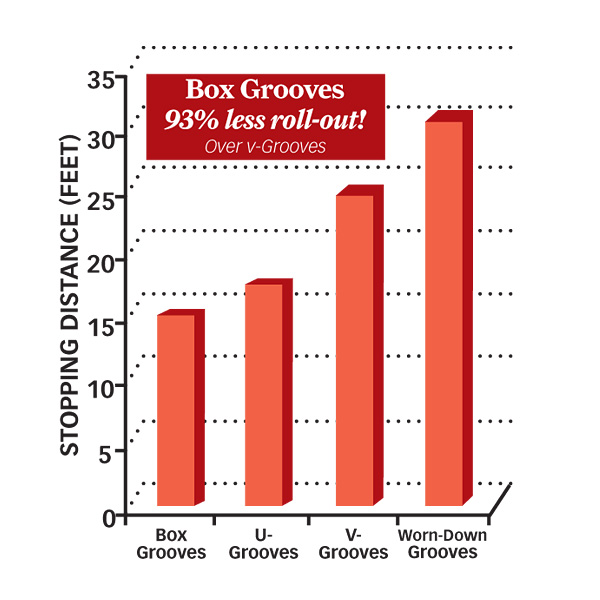
    When the groove structure is concerned, from the rough a U groove produces on average about twice as much spin as a V groove. From the fairway, U grooves produce about ten percent more than that. This is the main reason why the USGA made this ruling. PGA Tour players have much greater control with U grooves. The third factor that contributes to spin is the construction of the golf ball. Balls with a hard surlyn cover like most inexpensive distance varieties don't spin nearly as much as balls made with a urethane cover, like the Titleist Pro V1 and other high performance golf balls. Given all that info, the average golfer who uses a surlyn covered ball, doesn't produce a high amount of clubhead speed and doesn't hit the ball solid most of the time will see little or no effect on his results by switching to the new grooves. For the players on the PGA Tour, the sudden change may be difficult to adapt to. Ping and Titleist have opposed the change, siting player complaints and increased cost to manufacture the new grooves, but the rule change will go into effect as scheduled. I predict that the PGA Tour will go easy on the players in the first few months of the 2010 season by cutting down the rough. We'll see if that holds true. With the equipment resources available to modern tour players and the ball companies already testing softer golf balls, it's hard to feel any sympathy towards the players on this issue. Here's a great video made by the folks over at Cleveland Golf explaining the rule change:

    Subscribe to our email updates! You'll get the latest fresh news, reviews and stories delivered right to your inbox or RSS reader, and automatically be entered in our latest contests and giveaways! We are 100% SPAM FREE! Also, don't forget to check in with our Facebook fan page for exclusive content and get involved by leaving us comments on what you think!