Tag: TP

  • TaylorMade SLDR Mini Driver

    TaylorMade SLDR Mini Driver

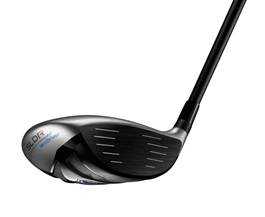
    Taylor Made adidas Golf (TMAG) has done it again. We’re used to seeing new clubs hit the market at several times during the year, but this time they’ve gone way beyond designing a new club – they’re invented a time machine! TMAG’s new time machine (aka – SLDR Mini Driver) takes us way back to the 1990s when shafts were shorter, heads were smaller and the center of gravity was close to the club face.  Naturally this new SLDR Mini Driver has modern shaft options, but the design concept is similar to the older clubs of the 90s to me. Based on the premise that many players struggle with the driver, they’ve built a 3 wood that is made to hit the ball off the tee for driver-like distance. So, if I understand correctly – It’s for people that want to hit their 3 wood almost as far as a driver, but not as far as a regular driver, but straighter than a regular driver, but not quite as straight as a 3 wood. Yeah. Tell you what – I’ll let TMAG explain it to you with their official press release below:

    Carlsbad, Calif. (April 7, 2014) – TaylorMade Golf Company, makers of the No. 1 played driver in golf, today announced the launch of the SLDR Mini Driver, a 260cc metalwood equipped with a 43.5” shaft, designed to promote distance and accuracy off the tee for players who frequently drive with their 3-wood. 

    TaylorMade research indicates that a high percentage of golfers, regardless of skill level, hit 3-wood off the tee more often than from the fairway. However, the 3-wood is designed to hit the ball off turf, not a peg. That void between product design and product use led to the development of the SLDR Mini Driver, which is engineered to be longer off the tee than a 3-woood and incredibly accurate.

    “Tour pros and betters amateurs often hit their 3-wood off the tee more often than from the fairway,” said Brian Bazzel, TaylorMade’s Senior Director of Metalwood Creation. “We embraced that fact to create a metalwood that’s sized between a 3-wood and driver and is designed to be easy to hit off a tee.”

    Like the SLDR driver – the No. 1 driver on the PGA Tour – the SLDR Mini Driver features a low-forward center of gravity (CG) location that reduces spin. From there, most players benefit from playing a higher loft (what TaylorMade calls “lofting up”) by combining a low spin-rate with a high launch angle, which are the launch conditions that promote maximum distance.

    The SLDR Mini Driver also incorporates TaylorMade’s Speed Pocket technology, which promotes lower spin on impacts low on the clubface, where the majority of driver mis-hits occur.

    And though it’s engineered to be easier to tee off with than a 3-wood, the SLDR Mini Driver is also easy to launch the ball off the turf with, thanks to its smooth sole that’s smaller and offers less resistance than a driver’s.

    Aesthetically, the SLDR Mini Driver’s sleek shape and smooth matte silver crown, black clubface and black button-back gives the club an attractive appearance from all angles, especially at address. The contrasting colors also facilitate easy and accurate face alignment.

    The first Tour pro to put the SLDR Mini Driver in play was Troy Matteson, who put not one but two in his bag at the Valero Texas Open: one to use off the tee and one to use from the fairway.

    “The SLDR Mini Driver is intended to appeal to a wide audience,” added Bazzel. “For the Tour pro or top amateur who places a premium on distance control and accuracy, this club is a fantastic option. It’s also a great choice for those amateurs who struggle with 460cc drivers.”

    Two SLDR Mini Driver models are available, standard and TP. The standard model retails for $279 and is equipped with a Fujikura 57 shaft. It is the same shaft used in the SLDR driver, but at 43.5 inches (two inches shorter than the SLDR driver) it promotes tighter dispersion for increased accuracy. The TP model retails for $379 and is equipped with Fujikura’s Motore Speeder 7.3 shaft and is built to a heavier, D5 swingweight for improved control. Lofts in both models range from 12°, 14° and 16°.

    Both SLDR Mini Driver models will be available at retail starting on 5/2. Visit TaylorMadeGolf.com for more information.

  • TaylorMade Golf Launches R11S Driver

    TaylorMade R11s DriverTaylorMade has always been at the forefront of metal wood technology, and the new R11S driver and fairway woods should be no exception. TaylorMade is known for releasing new clubs more frequently than most of the other golf companies out there, and while this leads to a small amount of customer frustration, it also means more innovation and saturation of the market which drives prices down on last year’s models, which is good for both TaylorMade and consumers. What follows is a press release from TaylorMade describing the new R11s driver. Enjoy!

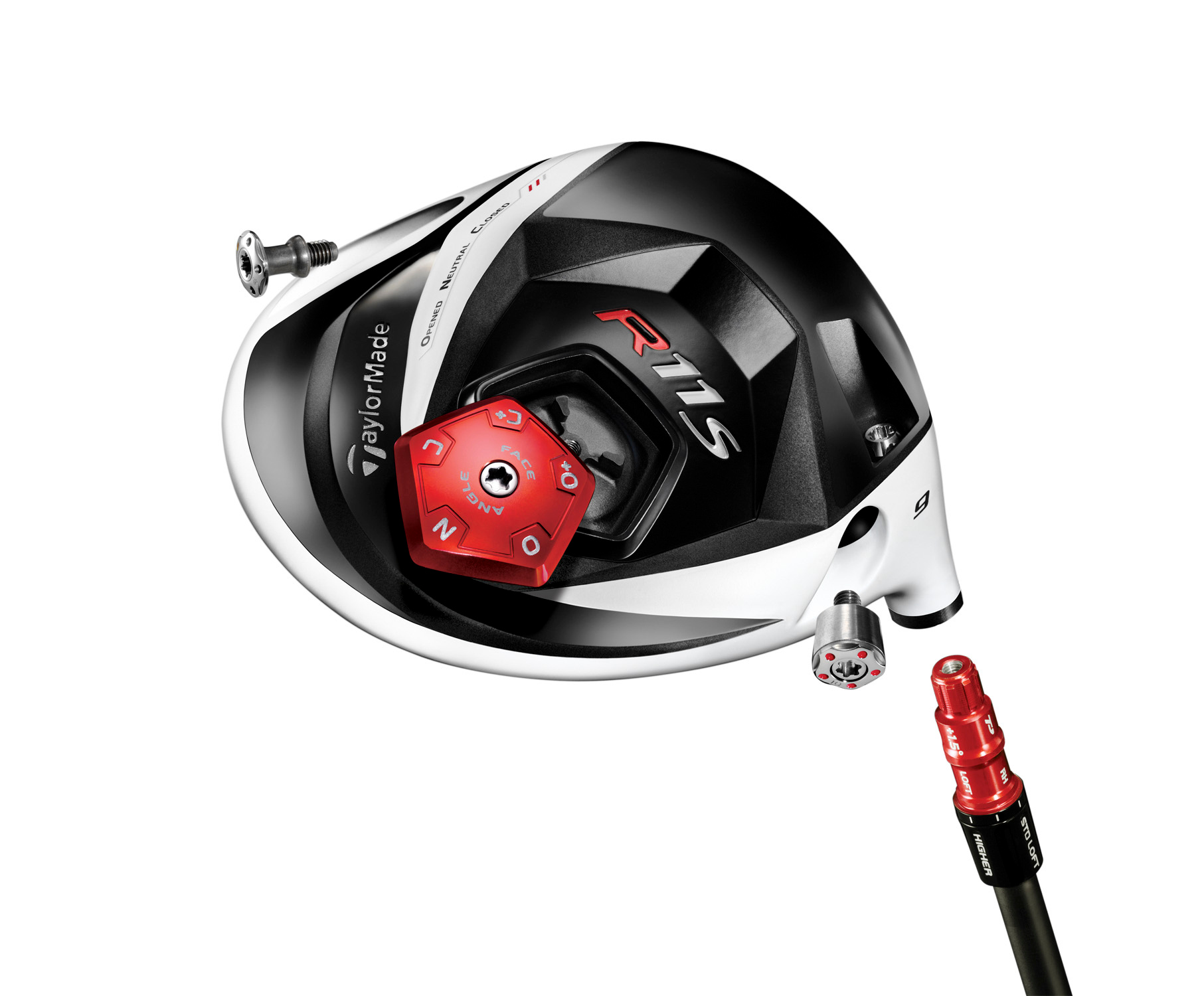
    CARLSBAD, Calif. (December 13, 2011) – TaylorMade Golf today launched R11S, the most technologically advanced driver to date. The all-white, USGA maximum 460cc R11S features a 3° Flight Control Technology (FCT) sleeve and an all-new 5-way Adjustable Sole Plate (ASP) which allows the golfer to find their optimum address set-up – a proprietary setting not found in any other driver. Combined with TaylorMade’s Movable Weight Technology (MWT), the new R11S driver can be tuned for 80 separate launch settings, making it the most adjustable driver in golf.

    “The R11S is a golfer’s dream come true; it’s the realization of every ounce of innovation, adjustability, and performance we could package in a bigger, more aerodynamic, white clubhead,” said Sean Toulon, executive vice president. “It would have been easy for our product creation team to rest on the laurels of the original R11™ driver, the most successful product we’ve ever created. Instead, we’re delivering golfers yet another significant advancement in adjustability and performance. And, with the proper fitting, we know golfers of all skill levels will be longer and straighter off the tee.”

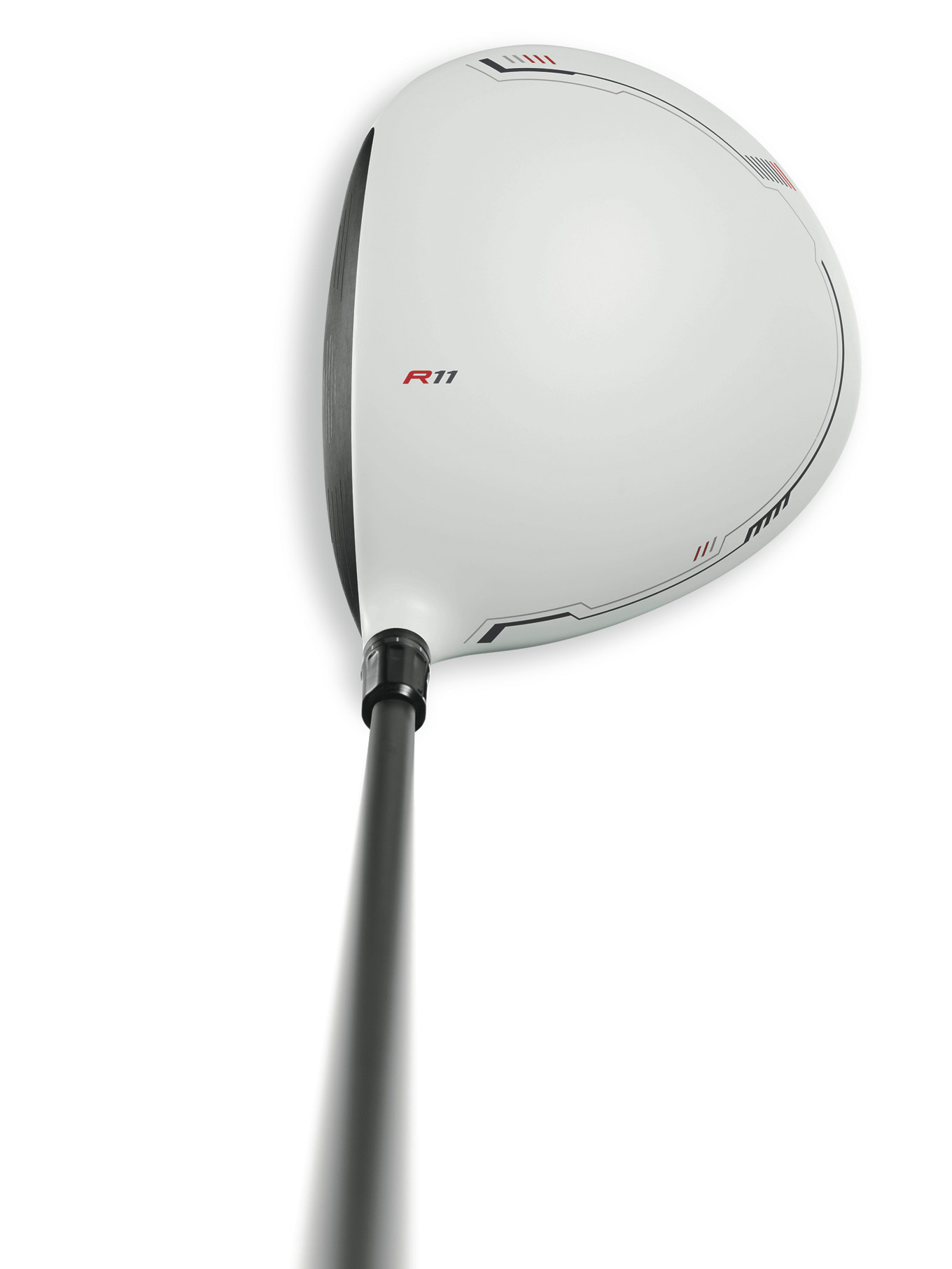
    At 460cc, the R11S is at the USGA limit for size. Similar to the original R11, the new R11S features a flat-white crown color and black PVD face to improve alignment and accuracy off the tee. Its address footprint measures more than 11,500 mm², and its white crown color makes it appear even larger (2%). That’s an advantage given that TaylorMade testing indicates that the majority of golfers gain confidence at address from a head that appears large relative to the ball.

    TaylorMade R11s Driver at AddressThe R11S driver’s modern-classical clubhead shape is intended to suit the eye of better players, while still providing ample forgiveness and confidence for average players. The head boasts a contemporary, slightly more triangular appearance than traditionally shaped drivers that provides higher MOI and a deeper, farther-forward CG position.

    New 5-Way ASP Provides More Tuning Options 
    ASP technology was a major performance breakthrough as it complimented Flight Control, a technology first introduced in the R9 family. When FCT is employed alone, the loft and face angle is coupled by the sleeve system. Adjustable Sole Plate technology allows the decoupling of loft and face angle by using a sole plate to adjust face angle independent of loft sleeve setting. Very simply, that means you can adjust the face angle independently of the loft, and vice versa. The five face angles made possible by the improved ASP Technology of the R11S are neutral, slightly open, open, slightly closed and closed.

    ASP Technology is characterized by a raised, five-pointed plate on the sole roughly the diameter of a quarter. Changing its position is easily achieved by loosening the screw that holds it to the sole, rotating the ASP, then re-tightening the screw.

    ASP works with FCT to create 40 combinations of loft and face angle, which can be used to further accentuate a face angle or counter a negative face angle due to a sleeve adjustment. It effectively doubles the range of face angle for the club for ±4° to ±6° or alternatively can create 5 lofts in 0.75° increments with the same face angle.

    Flight Control Technology
    Flight Control Technology allows you to change the orientation of the driver head with the shaft to effectively adjust the loft up or down, giving you 8 choices of lie and loft/face angles at range of 3° of lie and 3° loft/6° face angle for up to approximately 60 yards side-to-side trajectory adjustment and 3° and 1500 rpm of launch condition change.

    Movable Weight Technology 
    TaylorMade introduced Movable Weight Technology (MWT) in 2004 in the r7 quad driver. MWT gives golfers the ability to easily move discretionary weight to different areas of the clubhead to shift the CG location to promote changes in trajectory that produce greater distance and accuracy. Millions of TaylorMade metalwoods with MWT have been sold since the introduction of the r7 quad.

    Employing two widely spaced weight ports delivers 4 mm of CG change from heel to toe to promote up to 20 yards of side-to-side trajectory bias. The R11S includes two MWT cartridges, one weighing 10-grams and one weighing 1-gram. Configuring the weights properly is intuitive: To set up a neutral bias, install the heavy (10-gram) weight in the toe; to create a draw bias, install the heavy weight in the heel. If a more neutral setting is desired, 4- and 6-gram cartridges are available separately, and so are other cartridges of varying weights, which allow you to change the club’s swing weight as well as promoting changes in trajectory.

    TaylorMade R11s Driver

    Combining MWT, FCT and ASP
    Together, MWT, FCT and ASP allows for 80 launch-condition combinations, the most of any driver in existence. The total launch condition range is 3° and 1500 rpm by combining full FCT and MWT settings.

    Players can also adjust the weights to influence trajectory, either to enhance the launch conditions created by the face angle setting, or independent of the face-angle setting. For instance, some players prefer to look at an open face at address while still desiring a draw-bias performance. With the R11S driver, the player can open the face and install the heavy weight in the heel, resulting in an open face but a draw bias weighting.

    Inverted Cone Technology
    Like every TaylorMade driver since the R500 Series (launched in 2002), the R11S incorporates TaylorMade’s Inverted Cone clubface technology, which dramatically expands the COR zone, which is the portion of the clubface that delivers maximum ball speed.

    Shaft and Club Specs
    The R11S measures 45.75” and is equipped with an Aldila RIP Phenom 60 shaft (X, S, R and M flexes), which weighs 60 grams and which features a medium-firm tip profile.  RIP shafts feature Reverse Interlaminar Placement to provide more stability more stability at impact and promote more distance and control without the harsh feel associated with some firmer tip shafts.

    Grip: TM FCT. 
    Lofts: 9°, 10.5°, 12° in right-handed; 9° and 10.5° in left-handed. 
    Street price: $399.

    The R11S TP is equipped with an Aldila RIP Phenom TP 65 (X, S, R)
    25 additional TP shaft choices are also available. 
    Grip: TM FCT. 
    Lofts: 9°, 10.5° in right-handed; 9° and 10.5° in left-handed. 
    Street price: $499.

  • Premium 3 Wood Shootout

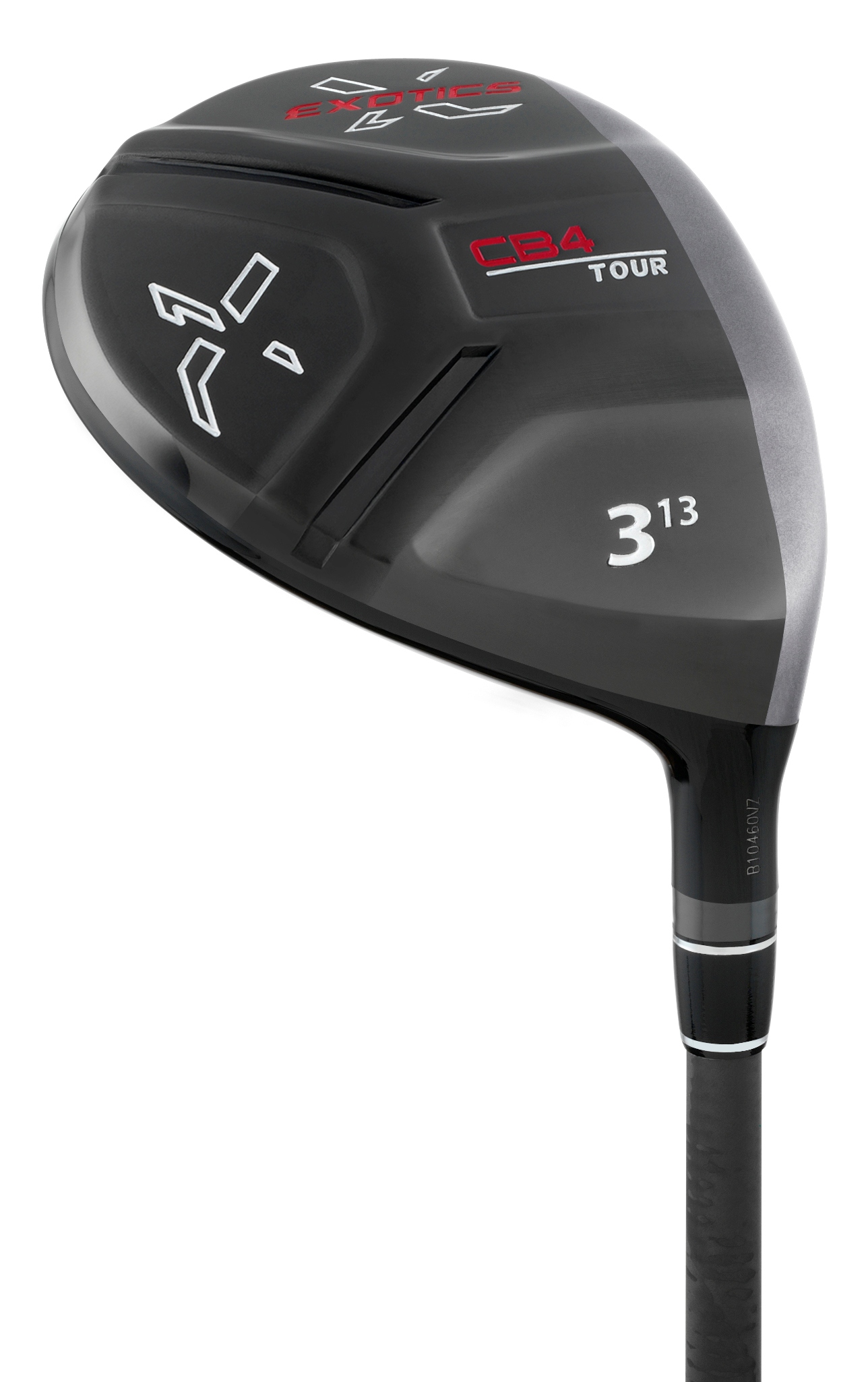
    Exotics CB4 Tour 3-WoodFor a while I’ve been searching for a replacement for my current 3-wood, which is an Adams RPM LP Tour Prototype with 13 degrees of loft, fitted with the awesome Fujikura Rombax 7W06 shaft. It is over five years old, but I have yet to find a club that can beat it. I put it in play at a US Open Qualifier 3 years ago and haven’t even thought about changing it until this year. Considering I picked it up for only $40 on eBay, I would say I got my money’s worth. I set out to test three new fairway wood models designed for better players in an effort to find the successor to the 3-wood throne in my golf bag. After several rounds and hundreds of range balls, I think I finally have a winner.

    Over the summer, I traded in a hybrid I won at a tournament for a Taylor Made R11 TP 3-wood, intending to sell it. When the buyer backed out I decided to give it a shot. It has 14 degrees loft and a Fujikura Motore F3 80x shaft. For the testing, it was set up neutral on the FCT adjustable hosel. I recently received the Tour Edge Exotics CB4 Tour 3-wood (15 degrees, Aldila RIP Sigma X-Flex) for review, and Nike Golf sent me their new VR Pro Limited Edition 3-wood (also 15 degrees, Diamana ‘Ahina, X-Flex) at the same time, so I decided to test the Exotics and Nike head-to-head with the Taylor Made. As a control, I used my trusty old Adams.

    Nike VR Pro Limited Edition 3-Wood All 3 clubs are fitted with high quality shafts, and all 3 are very solid feeling clubs. I didn't notice any measurable distance advantage with any club, but I would need to use a launch monitor to be sure. My Adams went the furthest, but that's because it has less loft than the others and I'm more familiar with it, having it in my bag for over 3 years. The Nike VR Pro Limited edition ($229 street price) and Exotics CB4 Tour ($299 street price) produced a mid-level ball flight that balloons just a tiny bit, but it’s predictable. The Taylor Made R11 TP ($299 street price) flew a bit lower with no ballooning (likely due to a stronger shaft and slightly lower loft). All 3 clubs are workable both ways, and they work well from a variety of lies. The Taylor Made tends to dig a bit and take a small divot, where the others glide over the turf. That is undesirable, and sometimes leads to fat shots and pop-ups. Both the Exotics and Nike look great, with no extraneous marks or graphics, but the Taylor Made is a bit distracting with the white paint, logo and pin stripes on the crown of the club. I’m not a big fan of the White clubs, but if they perform I can overlook it. For the most part, adjustable clubs seem like a marketing gimmick to me, but I really like the ability to adjust the club open or closed with the sole plate of the Taylor Made without having to remove the shaft. The adjustable FCT hosel has settings for lower or higher loft, but this is misleading. (See my note below for an explination) The Nike looks very clean and sharp, and the graphics and sole design are attractive. The all black head and shaft of the Exotics is very cool. I think if Darth Vader played golf, he would probably have this club in the bag. Taylor Made R11 3-Wood All three clubs sound great at impact but the Nike’s metallic click sounds the most like my gamer, so it wins the acoustic battle in my mind. However, some may prefer the CB4 Tour’s titanium click sound, which is a little higher pitched than the metal heads of the others. NOTE: Adjustable TaylorMade Woods & Dynamic Loft The TaylorMade R11 TP 3-wood features an adjustable design, allowing a player to adjust the club for lower, standard or higher loft. You can also adjust the sole plate to alter the face angle of the club. In theory this means the R11 can play at 13, 14 or 15 degrees of loft, but the way they achieve this is a bit confusing. Allow me to explain - When setting the R11's FCT hosel to the "lower" setting you think you are reducing the loft of the club from 14 to 13 degrees, but really what you are doing is simply opening the face angle of the club 2 degrees. Using an oft misunderstood concept called dynamic loft, when you open the face of a driver or fairway wood by two degrees and the club returns to the ball square, the resulting loft at impact will be about one degree lower, thus theoretically producing a lower ball flight. Conversely, if I set the club to the "higher" setting all I'm really doing is setting the clubface two degrees closed. When I make a swing and return the clubface back to the ball with a square face angle, the result is a higher dynamic loft of one degree and a higher ball flight. This is one reason why those closed faced, offset, slice-fighting drivers always seem to hit the ball so high. Since the sole plate of the R11 TP can also adjust the face angle of the club at address, you can create a paradox. For example - If you set the hosel on "lower" (open face) and set the sole plate to closed, the club will sit perfectly square, exactly the same as the neutral position. I can also set the sole plate to open, and the FCT hosel to "higher" (closed) and it is the same as the previous two settings. Perfectly square. The two adjustable features can cancel each other out, not affecting ball flight at all. Are you confused yet?

    Conclusions

    On the range and over the course of several rounds, I found every one of these clubs worthy of going in the bag, but in the end the Exotics beats the Nike by a slim margin. If price is a big factor for you, you may want to consider the Nike. The Taylor Made is a good club and performs well, but it was third in this test. A representative from Taylor Made told me their Superfast fairways would have fared better, so we'll revisit when I can test the Superfast. Don't feel too sorry for TaylorMade just yet, because the R11 (and R11 TP) Driver is one of the best on the market, and worth a hit for anybody. Here are my final notes:
    • The Exotics CB4 Tour has an edge in forgiveness over the Nike and Taylor Made, making it appealing to a broader range of players.
    • The Nike is the cheapest by $70, but the loft options are limited to 15 or 19 in the Limited Edition. You’ll have to buy the regular VR Pro to get the 13 or 17 degree lofts.
    • The Taylor Made is ugly. I like a clean, simple look. The the color, graphics and FCT hosel of the R11 TP makes this the ugly duckling of fairways.
    • With the option of all three clubs in my bag on the range, more people reached for the Exotics CB4 Tour first. Nuff said.

    Subscribe to our email updates! You'll get the latest fresh news, reviews and stories delivered right to your inbox or RSS reader, and automatically be entered in our latest contests and giveaways! We are 100% SPAM FREE! Also, don't forget to check in with our Facebook fan page for exclusive content and get involved by leaving us comments on what you think!

  • Win The Ultimate Fitting Experience On The TaylorMade Tour Van

    TaylorMade is having a contest! If you want a chance to receive a full fitting experience for you and three of your friends, just register your products and enter the contest using the link below.

    Our Next Tour Stop: Your House

    TaylorMade staff will pick you up in the TaylorMade Tour Van, drive you to your local golf course to show off, and build you a full set of clubs to your specs. I’ve had a chance to hit most of their latest offerings and I can tell you that TaylorMade is one of the few companies out there that made top line equipment for every spot in your bag. I just put their R11 TP 3-wood in the bag and it’s pretty darn good. The R11 driver is one of the hottest sellers on the market, and the xFT wedges have been around for a while and probably don’t get their fair share of attention in the very competitive wedge market. Check out the video below and register for your chance to win!

    Our Next Tour Stop: Your House. from TaylorMade Golf on Vimeo. If you are near one of TaylorMade's fantastic Performance Labs, you should stop by and see what they can do for you too. It's worth the trip!

    Subscribe to our email updates! You'll get the latest fresh news, reviews and stories delivered right to your inbox or RSS reader, and automatically be entered in our latest contests and giveaways! We are 100% SPAM FREE! Also, don't forget to check in with our Facebook fan page for exclusive content and get involved by leaving us comments on what you think!

  • TaylorMade Introduces R9 SuperDeep TP Driver

    TaylorMade SuperDeep TP Driver
    Click photo to zoom in...

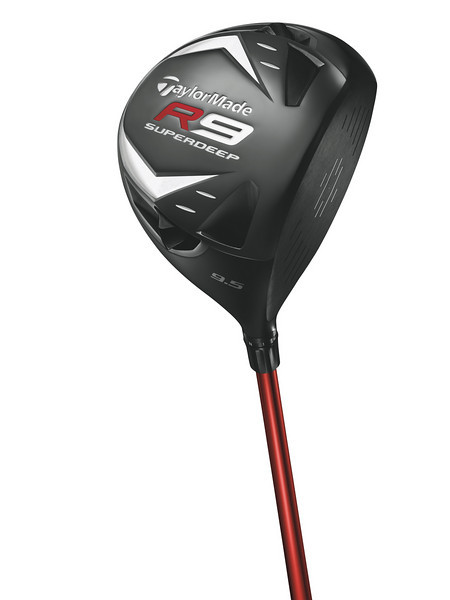
    TaylorMade Golf has released another new driver to the market, but this one isn’t for everyone. The new SuperDeep TP is a pure player’s driver, descended from the legendary 300 Tour and R510 TP, according to the following press release:

    CARLSBAD, Calif. (May 19, 2010) – TaylorMade, the No. 1 driver brand in golf, proudly introduces the R9™ SuperDeep TP, a pure player’s driver descended from the 300 Tour and R510 TP, both legendary among tour pros and highly skilled players.

    The R9 SuperDeep TP driver is engineered to promote a mid launch-angle and low spin-rate for strong swingers who tend to launch the ball too high and with too much spin with other drivers. The ultra-deep clubface (2.55 inches tall) is the deepest of any TaylorMade driver ever, and the head height is equal to the USGA limit (2.8 inches). The head is also more compact from heel to toe than other drivers like R9 SuperTri and Burner® SuperFast. This gives R9 SuperDeep TP a lower MOI which, combined with its forward CG location makes it more workable for players who like to shape their tee shots.

    Its combination of Flight Control Technology (FCT) and Movable Weight Technology™ gives you a choice of 448 possible launch condition combinations. R9 SuperDeep TP comes equipped with Aldila's new R.I.P. graphite shaft with Reverse Interlaminar Placement technology, which delivers low torque while promoting increased hoop strength and increased tip stability. Appearance-wise, R9 SuperDeep features an all-black finish, including the clubface, and includes TaylorMade's famous TP logo on the toe, and comes with an all-black headcover with magnetic closure. "This driver isn't for everybody," said Tom Olsavsky, TaylorMade senior director of metalwood development. "It was created for the select few who generate a rare combination of high clubhead speed, high clubhead control and high smash factor. If you're that player, this is the driver you've been waiting for." The R9 SuperDeep TP driver is available in three right-handed lofts (8.5, 9.5, and 10.5) and one left-handed loft (9.5). Three R.I.P. shaft flexes – R (60 grams), S (70 grams), X (70 grams). It includes a TP case with an R9 torque wrench (to adjust the FCT position and remove and install MWT® weights) and eight MWT weights: 1-gram, 4-gram, 6-gram, 8-gram, 10-gram, 12-gram, 14-gram and 16-gram. Availability starts on May 15, 2010 at a street price of $599. We'll have a SuperDeep TP to test and review very soon, so stay tuned for that one. If you are a five or below handicap and generate enough club head speed to hit the ball over 275 yards, you'll probably want to read about this driver! So far in our initial test hits, it's been very positive. Having hit about 20 balls with this beast, I can tell you that in stock form it is an anti-hook machine! The stock weights are set at 16g in the toe and 1g in the heel, creating a very fade biased setup. It hits low spinning bombs, but curiously not many on tour have put it in their bags, favoring the Burner SuperFast TP or SuperTri. Stay tuned!

    Want to win free stuff? Subscribe to our email updates! You'll get the latest fresh news, reviews and stories delivered right to your inbox or RSS reader, and automatically be entered in our latest contests and giveaways! Also, don't forget to check in with our Facebook fan page for exclusive content and get involved by leaving us comments on what you think!

  • TaylorMade Introduces Burner SuperFast TP Driver

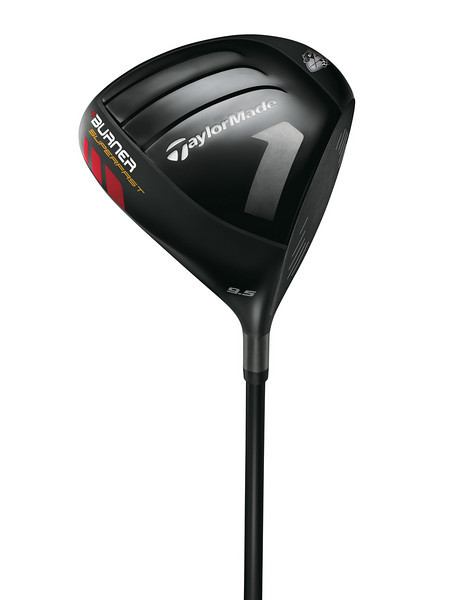
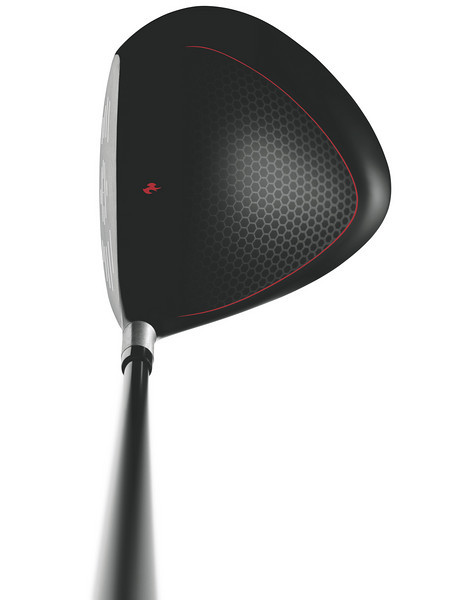
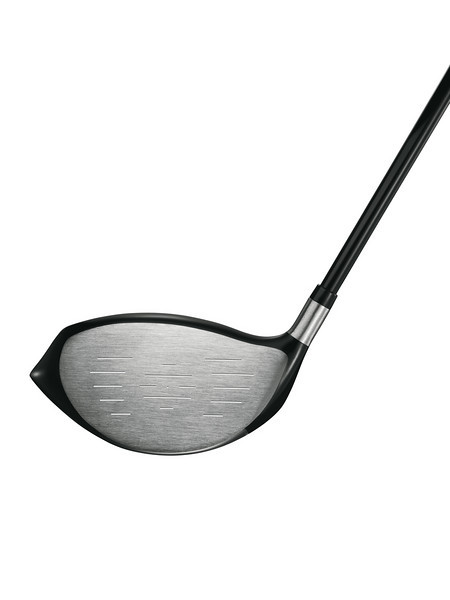
    TaylorMade Burner SuperFast TP DriverSleek Black Finish and Tour Preferred Face Alignment Combined with Burner SuperFast’s Aerodynamic Head

    TMAG Press Release – CARLSBAD, Calif. (May 18, 2010) – TaylorMade Golf is launching a TP version of its popular Burner SuperFast driver. Available to tour pros since March, the Burner SuperFast TP has been put in play by Retief Goosen, Y.E. Yang, Rory Sabbatini, Mike Weir, Pat Perez, Jason Day, Fred Funk, Justin Rose and Vaughn Taylor. Yang used it in April to win the Volvo China Open on the European Tour.

    “The players who have put Burner SuperFast TP in play have done so mostly because they’re getting more ball speed and distance with it,” said Keith Sbarbaro, TaylorMade’s vice president of tour operations. “The aerodynamics of the head promote more clubhead speed, and the big face and high MOI allow them to go after the ball more. Vaughn Taylor has never been considered a long hitter. A player came to our tour trailer and asked for a Burner SuperFast TP because he couldn’t believe how far Vaughn was hitting it past him in a practice round.”

    TaylorMade Burner SuperFast TP DriverThe Burner SuperFast TP features a fast, aerodynamic head shape, expansive clubface and slightly open clubface alignment. The inner side of the clubface incorporates TaylorMade's renowned Inverted Cone Technology, which promotes faster ball speed on off-center hits. The Burner SuperFast TP driver also incorporates TaylorMade's proven Dual-Crown technology, which both lowers and pulls back the center of gravity to promote a higher launch angle and less spin. Introduced in the TaylorMade Tour Burner driver two years ago, and also used in the Burner 09, Dual Crown technology is tremendously valuable. The Burner SuperFast TP driver is finished entirely in black, including the sole and clubface, and features a tour-inspired crown graphic and the famous TP logo on the toe. TaylorMade Burner SuperFast TP DriverNew Matrix Shaft Configuration Promotes Piercing Ball Flight Also critical to the Burner SuperFast TP driver's performance are its new Matrix shaft configurations, which promote a piercing, Tour-like ball flight and a stable feel. The Matrix HD6 (65 grams) shaft is in the S and X flexes, while the Matrix XCON 5 (54 grams) is the standard R-flex shaft. At 46.0" in length, Burner SuperFast automatically promotes a wide swing arc to promote increased clubhead speed. Available in three right-handed lofts (8.5, 9.5, 10.5) and one left-handed (9.5). Availability begins on May 15, 2010 at a street price of $349. I am still in the testing stages with this driver, but I can say the results have been very favorable so far. The feel is classic TaylorMade with a muted click at impact. This driver is workable and produces a nice controlled trajectory, with low spin. Stay tuned for a full review of the Burner SuperFast TP & the new SuperDeep Driver very soon!

    Want to win free stuff? Subscribe to our email updates! You'll get the latest fresh news, reviews and stories delivered right to your inbox or RSS reader, and automatically be entered in our latest contests and giveaways! Also, don't forget to check in with our Facebook fan page for exclusive content and get involved by leaving us comments on what you think!

  • TaylorMade Introduces TP xFT Wedge

    xFTWedge_34_prI received the latest press release from TMAG this week about the new TP xFT wedges, and I thought I would share it with everyone. A review is coming very soon so you can make a more educated choice as a consumer! Thanks for reading!

    Carlsbad, Calif. (November 16, 2009) – TaylorMade Golf has introduced the TP wedge with xFT (Exchangeable Face Technology), which allows players to easily remove a worn clubface and replace it with a new one to maintain peak performance in terms of spin and control.

    “Though the face of a typical iron is sturdy, it isn’t impervious to wear,” said Bret Wahl, senior director of iron, wedge and putter development. “A wedge’s face wears from contact with the ball and from the dirt and sand that’s often sandwiched between the ball and the face at impact. Every time you explode from sand with your wedge it’s like rubbing a piece of sand paper on your clubface. Over time the face wears down and the edge-radius of the grooves becomes dull. In addition to the normal wear and tear a face suffers from normal play, it can be nicked and damaged in a variety of other ways such as when clubheads bang together when you put your bag down or when you walk or drive your cart, or when you hit out of waste areas, or when you unintentionally scrape the clubface against debris when hitting the ball from poor lies off the fairway.”

    <

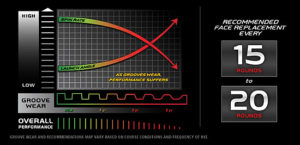
    p style=”text-align: center;”> The negative effect is three-fold: 1) The groove's edges lose the ability to grab the cover, reducing spin. 2) The groove loses volume into which moisture and debris once were channeled. Less groove volume means that more substances will come between the ball and the clubface, further reducing the amount of spin that can be imparted, especially from the rough. 3) The texture on the surface of the face (from milling or sandblasting) is reduced, which limits the face's grip on the ball. How quickly does the face of the average wedge show signs of wear? TaylorMade studies indicate that after about 1,000 shots the edge-radius of each individual groove changes and the roughness of the face surface is worn away. For players who play with reasonable frequency, 1,000 shots add up pretty quickly; they add up even faster for players who practice between rounds.

    Tour Pros and "Fresh Grooves"

    Tour pros are exceptionally mindful of the importance of wear on their wedges, and because of that they replace them frequently to get "fresh grooves" and a rough face surface for the maximum spin they deliver. Certain pros, including those in the top-tier, put new wedges in play every week, while some players change every three or four tournaments. Two members of the TaylorMade Tour Staff, Dustin Johnson and Jason Day, ask for a new 60° wedge every month. Other tour pros trade out at least three or four times per year. xFTWedge_assembly_pr One popular reason why many pros don't retire their wedges more often is because they've become accustomed to the club's look, weight, feel and sole grind, which influences the way the sole reacts with turf, rough and sand. And sometimes they have great confidence in a particular wedge that they've performed well with under pressure. Yes, such pros would like fresh grooves, but they don't want to give up the wedge they've become attached to. Occasionally you see a pro with a wedge so well-used that the lower-middle part of the face is worn almost smooth; a clear case of sentimentality keeping the club in the bag. Meanwhile, myriad amateurs would like to put new grooves in play with greater frequency, but can't justify the expense of buying new wedges once or more per year.
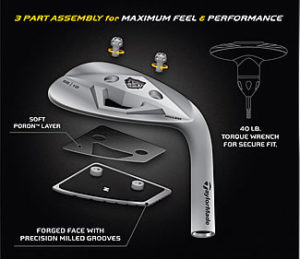
    xFT: Keep the Clubhead, Exchange the Clubface

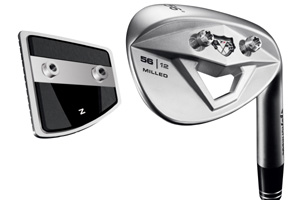
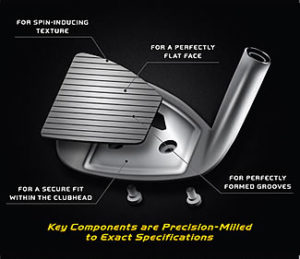
    xFT is a simple, cost-effective way to give tour pros and amateurs fresh grooves while allowing them to keep the same clubhead. Our new Exchangeable Face Technology (xFT), which is incorporated into our newest TP wedge design, allows you to quickly and easily exchange an old, worn wedge face with a brand new one. The xFT face is held in place with two screws located on the back of the clubhead that can be loosened and tightened with a white R9 torque wrench. Simply loosen the xFT screws to remove the old face and tighten the screws to lock in the new, fresh face. Each xFT face is backed with a thin layer of Poron®, which is a soft, urethane, microcellular foam to facilitate a tight fit within the clubhead and to cushion the face from metal-on-metal contact, and which also promotes superior feel. The clubhead and particularly the wedge face and the pocket the face fits into are precision-milled to fit snugly and securely together. The tolerances in terms of length, width and depth have to be extremely tight to ensure a tight fit, so that the TP xFT wedge feels the same, sounds the same and performs the same as a traditional one-piece clubhead. xFTWedge_exp_pr Each TP xFT wedge face is forged from soft 304 stainless steel, then completed with a four-step CNC precision-milling process. First, the surface of the face is milled flat. Second, the back and perimeter of the face are machined to ensure a precise fit into the pocket in the clubhead. Third, texture is milled onto the face surface. Fourth, the grooves are milled into the face with care taken to ensure that the depth, shape and edges are perfect. xFTWedge_milling_pr TP xFT Wedge and the USGA Rules Change on Grooves Two types of xFT wedge faces will be available for purchase, either with our new ZTP groove design that conforms to the USGA's new rules change, or with our current Z groove that conforms to the pre-2010 rule on groove design. (Older groove designs will be disallowed in high-level professional competitions starting January 1, 2010 by ruling of the USGA. However, recreational golfers aren't required to adhere to the groove-change rule until 2024). In 2011 and beyond, xFT wedge faces will incorporate only grooves that adhere to the new USGA rule, such as the ZTP groove. "In a nutshell, the rules change stipulates that new groove designs must have less cross-sectional area and their edges must be less sharp," says Wahl. "Most players won't experience a dramatic reduction in spin from dry fairway lies, but will see a decrease in spin by up to 50% from the rough. All the more reason to keep the clubface of your wedge fresh and at peak performance. Our new ZTP groove is the most aggressive, spin-inducing design we have that conforms to the new USGA rule."
    [TaylorMade Golf Accessories (10% Off with Promo: TM10)]

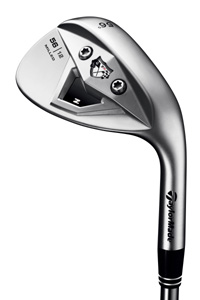
    Each TP xFT wedge head is fashioned in a classically beautiful teardrop shape made of stainless steel and milled for precision, including the pocket into which the clubface fits. The clubhead is plated in nickel-chrome for durability, then given a beautiful pearl finish to reduce glare. Availability in stores and online will begin December 1st with the 56° loft and 12° bounce only, with nine more combinations to follow in mid-February, 2010 -- 50.09, 52.11, 54.12, 56.16, 58.09, 58.12, 60.06, 60.10, 64.06. The 58.12 and 60.10 both incorporate TaylorMade's new C-grind sole, which was developed by our tour technicians and which is highly praised by tour pros for the multitude of greenside shots it permits you to play. xFTWedge_groovewear_pr TP xFT wedges are equipped with KBS High-Rev shafts, which are slightly heavier and feature a slightly longer tip parallel region compared to other wedge shafts. KBS' data indicates that the High-Rev shaft promotes increased spin because of its weighting, its kick and the way it presents the head to the ball. The High-Rev is new, making us the first brand to use it. We expect it to be played on tour, especially since the change in the groove rule will have players anxious to find ways to keep their spin-rates as high as possible. Because the shaft's unique design promotes additional spin, we expect the TP xFT wedge to gain wide acceptance on the PGA Tour. Each TP xFT wedge will sell at a street price of $129 per club and will come equipped with a Z groove face (conforming to the pre-2010 USGA rule). Individual xFT wedge faces with either the Z groove or ZTP groove (conforming to the new 2010 USGA rule) will be sold separately at a street price of $39.
    Want to win free stuff? Subscribe to our email updates! You'll get the latest fresh news, reviews and stories delivered right to your inbox or RSS reader, and automatically be entered in our latest contests and giveaways! Also, don't forget to check in with our Facebook fan page for exclusive content and get involved by leaving us comments on what you think!