
Tag: PGA Tour

  • Does Anybody Care About The FedEx Cup?

    Who will win the FedEx Cup?
    Who will win the FedEx Cup?

    The FedEx Cup was created in November of 2005 to add some excitement to the end of the PGA Tour golf season. Every professional sport seems to build towards a year end climax, giving the fans something to look forward to all season. On the PGA Tour we have the majors to fill that need. Unfortunately, after the PGA Championship the interest level of the fans and many players falls of significantly, and the television ratings reflect that.

    In the past, many of the top players would take breaks from the schedule as the holidays drew nearer, and many tournaments on the tail end of the PGA Tour schedule suffered from low ratings and a lack of star power. Tiger Woods’ emergence on the tour in the late 90s helped drive tournament purses to all time highs, and also made it more expensive to host a tournament. When he doesn’t play, the ratings and fan attendance fall off significantly. As a result, the sponsors don’t get their money’s worth and some were threatening to pull out. The PGA Tour needed a boost at the end of the season.

    Most of the other professional sports have a regular season that leads up to the playoffs, where an eventual champion is crowned for the year. The marketing minds in Ponte Vedra Beach thought this system would work too, and they dreamed up the FedEx Cup Playoffs.

    460x60 Lower Prices On NIKE SQ SUMO 5000 Drivers

    Starting in 2007, the FedEx Cup became a season ending points race similar to the one used in NASCAR. The top points earner becomes the FedEx Cup champion. In a sleeper, Tiger Woods won the first FedEx Cup by 12,000 points. Over the last two years the PGA Tour has changed the rules to address issues that arose the previous year. In 2008, the changes were designed to allow more golfers a chance to move up the points list as the playoffs go along, and penalize those who skip a playoff event. When Vijay Singh earned enough points in the first three events early in the 2008 campaign, he just had to show up the final week to claim the FedEx Cup. In November of 2008 they changed the rules once again to help ensure that the championship would not be won until the final event.

    This year at the season ending Tour Championship only the top 30 players will be eligible to play, with the points resetting so that any player in the field has a chance to win the cup. Any player in the top 30 can win, but the higher ranking players have the greatest chance. The first ranked player starts the Tour Championship with 2500 points, and the 30th ranked player starts the week with 210. Obviously this is to virtually ensure that the top 10 players have the greatest chance to win, since the tour is betting that the top players include most of the star personalities like Tiger, Phil, Ernie, Goosen, Furyk, etc.

    So the real question is – does anyone really care about the FedEx Cup? We’ve already mentioned that the television ratings go way up when Tiger is in the field, and the ratings go through the roof when Tiger is on the leader board with other names like Mickelson and Els in contention. If TV viewership is the sole indicator then the FedEx Cup Playoffs are a success. If you ask the players you might get different stories. The whole set up of the playoffs and the points structure are designed to keep the big names on your TV set all the way up to the silly season, which makes the sponsors happy and the tour rich. In fact, the Champions Tour and European tours have adopted similar playoff type systems called the Charles Schwab Cup and the Race to Dubai.

    Respect for a golf tournament is usually measured by who shows up to play it, and to a lesser extent by the prize money available. Many golfers would tell you that they would play a major championship like the Masters or US Open even if no prize money were offered, because they want to win a prestigious tournament that many of the games great have won in the past and winning these tournaments makes you a part of history. The FedEx Cup doesn’t have the history or the prestige of a major, but it has the prize money. I suspect we won’t be hearing too many young phenoms saying “I want to win the FedEx Cup.” when asked what they want to accomplish as a professional golfer.

    I don’t think the players really care about winning the FedEx Cup as much as they want to win the huge $10 million payout and five year exemption. I think this weakens the whole event into a frantic money grab. People just want to see their favorite players, they don’t care so much about the Cup. Besides, despite the rule changes the winner of the Tour Championship may not necessarily be the winner of the FedEx Cup, so who wants to see someone win the Cup without winning the last event? That would be like the Lakers winning the NBA Finals even if the Magic won the series because they won more games in the playoffs than Orlando. Reset everyone’s points to zero for the Tour Championship and make it a real shootout! Unfortunately I don’t think that will happen, because Tim Finchem wants to hand the Cup to Tiger or Phil, not to Heath Slocum or Ted Purdy.

    Let me know what you think. Should the FedEx Cup matter or is it a marketing gimmick? Will the FedEx Cup become a premier event that people really want to win? What do you think?
    468x60 Nike Final Clearance

  • About the USGA Groove Rule Change

    Photo courtesy golfdigest.com
    Photo courtesy golfdigest.com

    It seems that the USGA, golf’s governing body in the United States since 1894, has decided that players on the PGA Tour are able to generate too much backspin from shots out of the rough. They have decided to change the rule to limit the effect of grooves to produce backspin. Of course, it’s not quite that simple. You see, the rule applies only to certain players, certain clubs, and there is much misinformation out there about what is really going on with this rule, so I thought it would be good to set the record straight.

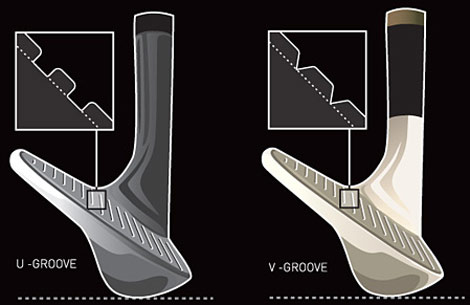
    Before 1984, all golf clubs had what we now refer to as V grooves. As it implies, the grooves on the face of the club were shaped like a V, with an angle of less than 90 degrees. In mid 1984, Ping introduced the second version of the Eye2 irons featuring U grooves following a very public battle with the USGA to allow them. The next year, they designed the square groove. I bet you thought a square groove was the same as a U groove didn’t you? The design was the same, but the difference was that they modified the grooves to create a slight radius at the top of the groove. This change reduced the amount of surface area between the groove, but didn’t change the distance between the inside edges of the grooves.

    Fast forward to 2009, and the USGA is finally pulling the trigger on a rule change related to square grooves, or U grooves, or box grooves. One of the biggest misconceptions about this rule change is that the USGA is banning square grooves. This is not the case at all. In fact, it doesn’t govern what shape the grooves can be any more than the current rule that has been in effect since 1984. Club companies can continue to make U or square grooved clubs. The new rule, as it it currently written, calls for a club’s grooves to be straight and parallel, have a symmetrical cross section and must have sides which do not converge. Also, the spacing and width of the grooves must be consistent across the face.

    The new rule actually changes the way club faces and grooves must be manufactured in three ways: One - because square grooves can channel away more grass and moisture, they now must be placed further apart on the face than previously. Two – The milling process many manufacturers use now creates a very precise and sharp edge. In an effort to dull those edges, a new measurement has been added to the rule which calls for a minimum radius of .010” on the groove. This effectively rounds off the corner of the groove edge, in theory producing less bite on the ball. Three – It allows for a condition of competition, which means that the implementation and subsequent enforcement of the rule is up to the tournament committee. It also states that the rule will only be applied to tournaments or competitions involving expert players. In other words, the rule will only go into effect on the PGA Tour, USGA, and other high level competitions. Those are the facts about the rule. We know the PGA Tour has stated that they will adopt the rule starting January 1, 2010, followed by other top level events, such as the USGA championships, in 2014. What does this mean to the average every day golfer and weekend hack? Not much. All rounds played for handicap purposes must use conforming grooves starting in 2024. Obviously by aiming this rule squarely at the PGA Tour, they are saying that they want to re-emphasize the importance of hitting the ball in the fairway again. In recent years with the changes in grooves and golf balls and the increased distance players are hitting it, it was more desirable to hit a wedge out of the rough than an 8 iron from the fairway. The USGA simply wants players at the highest levels to return to having to judge the lies in the rough to avoid flyers, or be a bit more creative around the greens with chip shots. By taking spin off the ball we don't have to grow the rough to 6 inches or speed up the greens to 14 on the stimpmeter. So what will the impact on our scores be? After all, most average golfers shoot scores between 90 and 100. Will the groove change really make it tougher on us? Personally, I don't think so. For one, the average golfing public doesn't have to switch clubs until 2024. That gives everybody a good 15 years to get a few short game lessons along the way. Secondly, most golfers don't generate much spin on their shots anyway. I contacted renowned short game expert Dave Pelz for his scientific expertise on the subject and here's a summary of what he told me. Three factors contribute to generating spin on a golf ball: The quality of the swing, the groove structure and the ball itself.

    [caption id="attachment_307" align="alignright" width="600" caption="Photo courtesy Golf.com"]Photo courtesy Golf.com[/caption] In terms of swing quality, to produce spin on a golf ball you need solid contact and a fast moving club. Most PGA Tour players swing much more aggressively on short pitch shots and chips than amateurs. As a result, they hit the ball with more spin. Tiger and Phil have often befuddled crowds with the low flying pitch that bounces twice and stops on a dime.
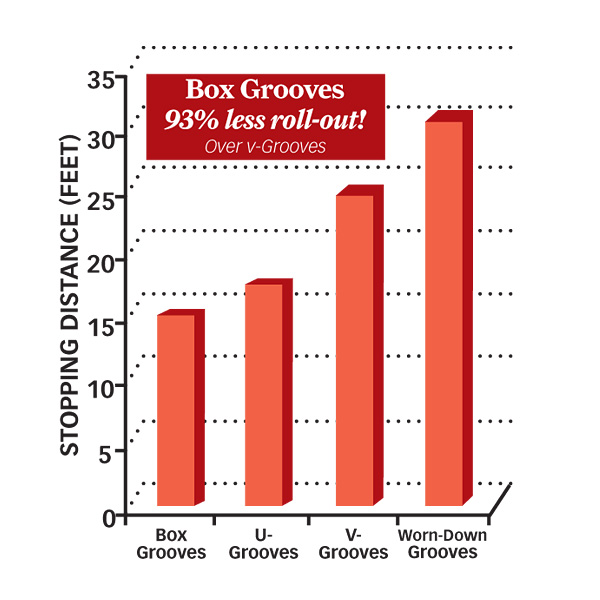
    When the groove structure is concerned, from the rough a U groove produces on average about twice as much spin as a V groove. From the fairway, U grooves produce about ten percent more than that. This is the main reason why the USGA made this ruling. PGA Tour players have much greater control with U grooves. The third factor that contributes to spin is the construction of the golf ball. Balls with a hard surlyn cover like most inexpensive distance varieties don't spin nearly as much as balls made with a urethane cover, like the Titleist Pro V1 and other high performance golf balls. Given all that info, the average golfer who uses a surlyn covered ball, doesn't produce a high amount of clubhead speed and doesn't hit the ball solid most of the time will see little or no effect on his results by switching to the new grooves. For the players on the PGA Tour, the sudden change may be difficult to adapt to. Ping and Titleist have opposed the change, siting player complaints and increased cost to manufacture the new grooves, but the rule change will go into effect as scheduled. I predict that the PGA Tour will go easy on the players in the first few months of the 2010 season by cutting down the rough. We'll see if that holds true. With the equipment resources available to modern tour players and the ball companies already testing softer golf balls, it's hard to feel any sympathy towards the players on this issue. Here's a great video made by the folks over at Cleveland Golf explaining the rule change:

    Subscribe to our email updates! You'll get the latest fresh news, reviews and stories delivered right to your inbox or RSS reader, and automatically be entered in our latest contests and giveaways! We are 100% SPAM FREE! Also, don't forget to check in with our Facebook fan page for exclusive content and get involved by leaving us comments on what you think!

  • Tiger wins at Bay Hill – Again

    1224243730801_11 Did Tiger win it, or did Sean O’Hair lose it? I think maybe a bit of both. Clearly Tiger had to make that 16 footer on the last hole to win, but O’Hair dumped one in the water on 16 to give Tiger a free pass. It’s easy to sit here and play Monday morning quarterback; wondering what could have happened if Sean did this, or Tiger did that, but a few things are certain. It seems that no one is able to play well on the back nine on Sunday in the presence of Tiger, and no matter how long he has been away or how he played up to that point, Tiger is the most opportunistic player of this generation. When an opening presents itself, few players in history are able to seize the moment like Tiger. One great example of this was the clutch par save on 16 after O’Hair dumped a ball in the water.

    That hole was the pivotal point in the round to me. Even though his play was sloppy and he was obviously nervous, O’Hair was still in control and ahead by one shot. After Tiger pushed one into the trees requiring a certain lay up, Sean O’Hair hit a ball that came up 2 clubs short and rolled back into the water. You could clearly see that Tiger knew he had been let off the hook and given an opening. He responded with a great hook spinning wedge shot and a par to O’Hair’s bogey, taking the lead into the 17th. O’Hair has been here before. At the ’08 Player’s Championship he dumped 2 balls in the water at 17 to lose to Sergio Garcia. However – That day he was behind and going for the win by shooting at the flag. Sunday, he was defending a lead and going at the fat side of the green. Despite a Woods bogey on 17 to draw back even with O’Hair, after the approach shots into 18, I could sense that O’Hair new he was defeated. With the sun setting and the flash bulbs popping, there wasn’t a true golf fan in the world that thought Tiger would miss that putt.

    So, did Tiger win it or O’Hair lose it? Most of the time Tiger gets credit for winning tournaments. I think this time Sean O’Hair lost it. Better luck next time Sean. Maybe next time your final round opponent will be Phil the Thrill…