Tag: Ping Eye 2

  • Square Groove Drama – Phil Mickelson Accused of Cheating!

    Photo: Denis Poroy

    As most golf fans are aware, on Jan 1, 2010 a new condition of competition went into effect on the PGA Tour that mandated a change in the shape and volume of grooves on clubs having more than 25 degrees of loft. This new groove rule has caused outrage and much discussion for several months now. The golf club manufacturers have spent millions of dollars re-tooling their equipment to make the new grooves and meet the demand by their staff professionals to test and adopt the new clubs.

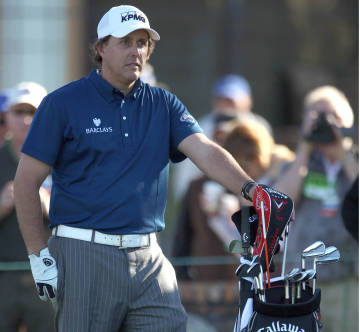
    The biggest opponent of the new rule on the PGA Tour has been Phil Mickelson, who has repeatedly bashed the rule changes and defended the position of the clubmakers. Last week, Golf Digest reported that Phil Mickelson was at Callaway Golf’s Carlsbad California testing center prepping a new set of irons, and experimenting with a few 20 year old Ping Eye2 wedges, which have square grooves. These wedges if manufactured now would be non-conforming, but because of a lawsuit between Ping and the USGA that was settled in 1990, any Ping Eye2 made before April 1, 1990 was grandfathered in and remains approved for play. The lawsuit takes precedence over any rule change.
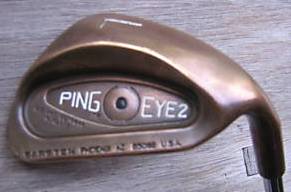
    Ping Eye 2 LW
    Ping Eye 2 LW

    Phil Mickelson isn’t the only player who has taken advantage of this loophole in the new rule. In fact, he got the idea after reading that Dean Wilson and John Daly had put the old clubs in their bags for the Sony Open in Hawaii. Since then, more players have gone back to the older wedges in search of more spin from the rough.

    This week at Torrey Pines in San Diego, PGA Tour veteran Scott McCarron said using the old wedges was cheating, and he claimed he was appalled that Phil had put it into play. In a sport that is known as a gentleman’s game , accusing someone of cheating is a serious matter. However, Mickelson took the high road with his response, instead turning the blame squarely back on the USGA by saying “It’s a terrible rule. To change something that has this kind of loophole is nuts,” Mickelson said. “But it’s not up to me or any other player to interpret what the rule is or the spirit of the rule. I understand black and white. And I think that myself or any other player is allowed to play those clubs because they’re approved — end of story.”

    McCarron defended his comments by explaining that he was not singling out Phil for cheating, but rather every player that put one of the old wedges into play because he through it was violating the spirit of the rule. That the USGA and PGA Tour didn’t anticipate this rub is interesting. McCarron said the issue would likely be brought up at a Players Advisory Counsil meeting next week, of which McCarron is a part of.

    <

    p style=”text-align: center;”> Mickelson made no apologies however. He said he submitted wedges to the USGA that met the new requirements, yet they were not approved. Conversely, The Eye2 wedge is approved but does not conform under the new rules. He also said testing procedures are different in the United States and overseas, adding to the frustration. "This whole groove thing has turned into a debacle," Mickelson said. Mickelson said he wasn't sure if he would continue to play the Ping wedge, because he didn't find much difference in spin from that and the regulation grooves in his other Callaway wedges. "There's a good chance I'll switch back, but not for the reason that I feel like I've been doing something wrong," Mickelson said. "I think that any player using these clubs that are approved under the rules of golf are fine." The PGA Tour has the ability to make a local rule which would outlaw the use of those wedges stemming from a 1993 settlement with Ping containing different conditions, but the Tour has yet to make any ruling in the matter. Phil Mickelson is currently a few shots from the lead. Scott McCarron missed the cut.

    Want to win free stuff? Subscribe to our email updates! You'll get the latest fresh news, reviews and stories delivered right to your inbox or RSS reader, and automatically be entered in our latest contests and giveaways! Also, don't forget to check in with our Facebook fan page for exclusive content and get involved by leaving us comments on what you think!
  • About the USGA Groove Rule Change

    About the USGA Groove Rule Change

    It seems that the USGA, golf’s governing body in the United States since 1894, has decided that players on the PGA Tour are able to generate too much backspin from shots out of the rough. They have decided to change the rule to limit the effect of grooves to produce backspin. Of course, it’s not quite that simple. You see, the rule applies only to certain players, certain clubs, and there is much misinformation out there about what is really going on with this rule, so I thought it would be good to set the record straight.

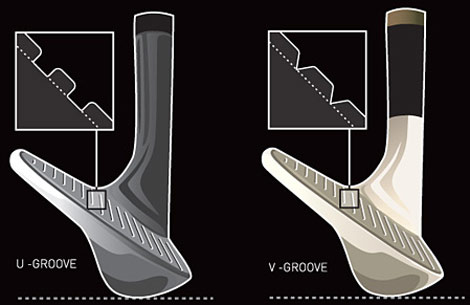
    Before 1984, all golf clubs had what we now refer to as V grooves. As it implies, the grooves on the face of the club were shaped like a V, with an angle of less than 90 degrees. In mid 1984, Ping introduced the second version of the Eye2 irons featuring U grooves following a very public battle with the USGA to allow them. The next year, they designed the square groove. I bet you thought a square groove was the same as a U groove didn’t you? The design was the same, but the difference was that they modified the grooves to create a slight radius at the top of the groove. This change reduced the amount of surface area between the groove, but didn’t change the distance between the inside edges of the grooves.

    Fast forward to 2009, and the USGA is finally pulling the trigger on a rule change related to square grooves, or U grooves, or box grooves. One of the biggest misconceptions about this rule change is that the USGA is banning square grooves. This is not the case at all. In fact, it doesn’t govern what shape the grooves can be any more than the current rule that has been in effect since 1984. Club companies can continue to make U or square grooved clubs. The new rule, as it it currently written, calls for a club’s grooves to be straight and parallel, have a symmetrical cross section and must have sides which do not converge. Also, the spacing and width of the grooves must be consistent across the face.

    The new rule actually changes the way club faces and grooves must be manufactured in three ways: One – because square grooves can channel away more grass and moisture, they now must be placed further apart on the face than previously. Two – The milling process many manufacturers use now creates a very precise and sharp edge. In an effort to dull those edges, a new measurement has been added to the rule which calls for a minimum radius of .010” on the groove. This effectively rounds off the corner of the groove edge, in theory producing less bite on the ball. Three – It allows for a condition of competition, which means that the implementation and subsequent enforcement of the rule is up to the tournament committee. It also states that the rule will only be applied to tournaments or competitions involving expert players. In other words, the rule will only go into effect on the PGA Tour, USGA, and other high level competitions. Those are the facts about the rule.

    We know the PGA Tour has stated that they will adopt the rule starting January 1, 2010, followed by other top level events, such as the USGA championships, in 2014. What does this mean to the average every day golfer and weekend hack? Not much. All rounds played for handicap purposes must use conforming grooves starting in 2024. Obviously by aiming this rule squarely at the PGA Tour, they are saying that they want to re-emphasize the importance of hitting the ball in the fairway again. In recent years with the changes in grooves and golf balls and the increased distance players are hitting it, it was more desirable to hit a wedge out of the rough than an 8 iron from the fairway. The USGA simply wants players at the highest levels to return to having to judge the lies in the rough to avoid flyers, or be a bit more creative around the greens with chip shots. By taking spin off the ball we don’t have to grow the rough to 6 inches or speed up the greens to 14 on the stimpmeter.

    So what will the impact on our scores be? After all, most average golfers shoot scores between 90 and 100. Will the groove change really make it tougher on us? Personally, I don’t think so. For one, the average golfing public doesn’t have to switch clubs until 2024. That gives everybody a good 15 years to get a few short game lessons along the way. Secondly, most golfers don’t generate much spin on their shots anyway. I contacted renowned short game expert Dave Pelz for his scientific expertise on the subject and here’s a summary of what he told me. Three factors contribute to generating spin on a golf ball: The quality of the swing, the groove structure and the ball itself.

    Photo courtesy Golf.com

    In terms of swing quality, to produce spin on a golf ball you need solid contact and a fast moving club. Most PGA Tour players swing much more aggressively on short pitch shots and chips than amateurs. As a result, they hit the ball with more spin. Tiger and Phil have often befuddled crowds with the low flying pitch that bounces twice and stops on a dime.

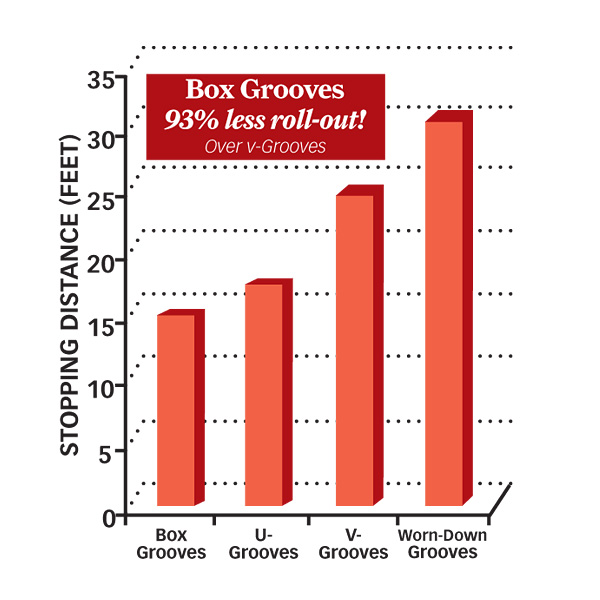
    When the groove structure is concerned, from the rough a U groove produces on average about twice as much spin as a V groove. From the fairway, U grooves produce about ten percent more than that. This is the main reason why the USGA made this ruling. PGA Tour players have much greater control with U grooves.

    The third factor that contributes to spin is the construction of the golf ball. Balls with a hard surlyn cover like most inexpensive distance varieties don’t spin nearly as much as balls made with a urethane cover, like the Titleist Pro V1 and other high performance golf balls.

    Given all that info, the average golfer who uses a surlyn covered ball, doesn’t produce a high amount of clubhead speed and doesn’t hit the ball solid most of the time will see little or no effect on his results by switching to the new grooves. For the players on the PGA Tour, the sudden change may be difficult to adapt to. Ping and Titleist have opposed the change, siting player complaints and increased cost to manufacture the new grooves, but the rule change will go into effect as scheduled. I predict that the PGA Tour will go easy on the players in the first few months of the 2010 season by cutting down the rough. We’ll see if that holds true. With the equipment resources available to modern tour players and the ball companies already testing softer golf balls, it’s hard to feel any sympathy towards the players on this issue.