
Tag: golf club

  • High Heat Driver – Game Changing Technology For Amateurs

    High Heat Driver – Game Changing Technology For Amateurs

    high heat soleKnuth Golf may be a new player in the golf equipment market, but the company’s namesake is anything but. Dean Knuth spent many years working with the USGA to develop and evolve the current course and slope rating system that is used to establish, maintain and adjust player handicaps different courses.

    With degrees in mathematics and computer science and decades of service to golf, Dean was the obvious choice to design the first driver that is specifically made with the amateur golfer in mind, not the pros on tour. So what does it take to design a club for amateur golfers, and how does it differ from other drivers on the market?

    The Technology

    Amateur golfers don’t swing like the pros, so why play the same driver the pros play? Knuth’s High Heat driver is designed to help slower swing speeds of amateur golfers, and it does that by offering a driver with a center of gravity (CG) that is 25% deeper and 18% lower than any on the market.

    What does a low and deep CG do? Simple. It makes the club easy to hit! The deep and low CG of the High Heat driver allows golfers with slower swing speeds to launch the ball higher with less spin than other drivers. Another benefit of the deep, low CG is forgiveness. Since most mid-to-high handicap golfers tend to hit the ball lower on the face, the low CG is a great benefit to help get the ball airborne.

    “High MOI” is technical term that golf companies are tossing around these days. MOI, or Moment of Inertia is simply a measure of resistance to twisting. What high MOI means for a golf club is more distance and better accuracy on off-center hits. The High Heat has a higher MOI than just about every driver on the market. Terms like moment of inertia and low CG sound cool for a testing lab, but in the real world what it means is you get a club that is very easy to hit solid, and very forgiving when you miss it a bit.

    Visually Stunning

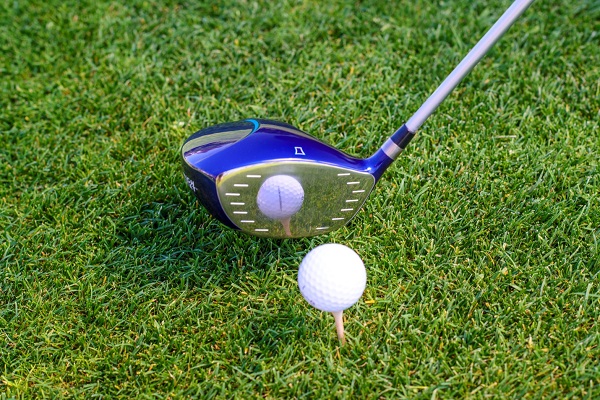
    high heat faceThe first thing you’ll notice about the High Heat driver is the sleek cobalt blue paint job and the shiny mirror face. The cobalt blue is striking and sharp, and gives the High Heat an identity that is unmistakable. The blue color scheme was also favored because it mimics the color of a flame when it burns the hottest. The polished mirror face is functional as well as being aesthetic. When hit, the ball leaves dimple marks on the face telling you where you made contact, and simply wipe away with a soft towel. Plus you can use it to deflect sunshine into your opponent’s eyes while he’s hitting! (wink)

    Specifications

    The High Heat driver comes in right and left handed models in three lofts – 9.5, 10.5 & 12 degrees. Standard length is 45 inches. There are also four premium shaft options to choose from: Fujikura Pro Sakura, Fujikura Pro 53, 63 and 73 and the Aldila Magnum 44. My testers had the Fujikura Pro 73 in X-Flex and the Fujikura Pro 63 in Stiff flex.

    Play Testing

    I spent quite a bit of time playing and testing the High Heat, and put it in as many players’ hands as I could to get as much feedback as possible. After half a dozen rounds with it I can conclude that the High Heat is one of the most playable and forgiving drivers I’ve ever seen.

    Someone like me who swings over 110 MPH and hits the sweet spot with regularity won’t see as much benefit from the High Heat as the average golfer, but even for me it was very accurate and forgiving on mishits. For the other 95% of golfers out there, this driver is a game changer. The low & deep CG really helps players with slower swing speeds launch the ball higher with less spin while still being very forgiving and playable.

    Many of the play testers that tried the High Heat said that it had a huge sweet spot and the ball seemed to shoot off the face with a springy feel. The noise was also distinctive. It sounds a bit like hitting the ball with an aluminum baseball bat. Most testers I gave it to gained distance with the High Heat, and not surprisingly the golfers with the slowest swings seemed to get the most out of it.

    In my personal testing I got great results from the High Heat, even with my tour-level swing speeds. While it is designed primarily for average golfers, any golfer can benefit from it. In my case I saw better forgiveness and excellent accuracy. The look and sound are unique, but not off-putting by any means. Personally I think the driver is gorgeous.

    Machine Testing

    hhcrownKnuth Golf saved me the trouble of inventing a golf swing robot to test their club against the other leading drivers on the market. Instead, they contracted with Golf Labs, the most reputable independent golf testing company in the world. Below is an excerpt of the results of that testing provided by Knuth Golf:

    On October 29, 2014 on a clear and relatively calm day in the San Diego area, Golf Labs tested the High Heat driver and Major Brands on its range using their precision robotic tester set at 95 mph.

    High Heat’s submission, identified as D-12 on the hosel, was marked 10.5 loft on the sole and was shafted with a Fujikura Pro 853 Stiff flex 53 gram shaft. It was tested against the Major Brands’ 10.5 lofts with their standard Stiff flex shafts. The testing was conducted against TaylorMade SLDR, Ping G30, Titleist 915 D2, Callaway Big Bertha Alpha, and Nike Covert 2.0.

    Golf Labs’ test used its standard 5 point test which provides total distance and dispersion from the center line on center and four off-center hits based on hitting six balls at each of those 5 points. The four off-center hit locations are located 1⁄2” above and below the center of each driver’s face; and 3⁄4” to the right and to left of center. Golf Labs also used new Titleist NXT golf balls.

    Golf Labs’ test results showed that High Heat’s total distance on center and off-center hits toward the center line was the longest, its total dispersion was the lowest and it had the most forgiveness than any of the Major Brands with one partial exception. The only exception was Callaway’s Big Bertha Alpha total distance toward the center line on center hits was the longest but High Heat’s total distance toward the center line for off-center hits was longer than Callaway’s Big Bertha Alpha and High Heat’s total dispersion on center and off-center hits was lower than Big Bertha Alpha.

    Final Thoughts

    The High Heat driver from Knuth Golf is a game changer. It has the lowest and deepest CG in the industry and is one of the most forgiving, easy to hit clubs I’ve ever hit. If you believe high performance can only come from a name-brand driver, you’ll be shocked when you hit this one. As soon as you hit it, I’ll bet you will want to put it in the bag. Many of Knuth’s happy customers have been prodding him for the past year or so with the inevitable question – When will you make fairway woods and hybrids? The answer is – Very soon!

    Knuth Golf introduced their new fairway woods and hybrids at the 2016 PGA Merchandise Show in Orlando, Florida, and they will be available in time for the 2016 golf season. The High Heat driver sells for $399 direct, but you don’t have to pay that much. In fact, to save $70 check out the special offer below! For more information on all the clubs available from Knuth Golf, visit their website at www.knuthgolf.com

    Special Offer

    We have arranged for a special price of $329 for the High Heat driver, which also has a 30 day full money back guarantee. Just go to www.knuthgolf.com, add the driver to your shopping cart, and at checkout simply select Intothegrain.com when asked how you heard about High Heat. Happy shopping!
  • Introducing the TaylorMade JetSpeed Family

    TaylorMade JetSpeedThanks to their position as an industry leader and backed by their parent company the adidas Group, TaylorMade loves pumping out new clubs at a furious pace, often staggering their product launches throughout the year. It seems like they have a new driver on the market every 6 months. Earlier this year, the R1 Black was released, followed soon after by the new SLDR driver, now we have another new toy to play with. Here’s the official TaylorMade JetSpeed press release:

    TaylorMade Golf Introduces JetSpeed Driver, Fairway Woods and Rescue Clubs

    New Speed Pocket design unites with low CG and light weight to promote high launch and low spin for maximum distance

    CARLSBAD, CALIF. (November 15, 2013) – TaylorMade, the No. 1 played driver brand on the PGA Tour, today announced the release of JetSpeed, a breakthrough line of metalwoods that includes the company’s first driver to feature Speed Pocket technology. In addition, JetSpeed fairway woods and Rescue clubs combine an enhanced Speed Pocket, an extremely low-forward center of gravity (CG) location and extremely light overall weight to promote faster swing speed, clubhead speed and ball speed for more distance.

    “We expect ‘low and forward CG’ to represent the next great innovation in metalwood performance,” said Sean Toulon, Executive Vice President. “With our SLDR and JetSpeed products, we’re giving golfers of all types the opportunity to increase their launch angle and reduce their spin-rate, which ultimately leads to more distance.”

    The First Driver with a Speed Pocket

    The Speed Pocket was originally designed to increase the speed at which the clubface flexes and rebounds to promote faster ball speed. Why put a Speed Pocket in a driver, since the face is already as fast as the USGA will allow? TaylorMade engineers discovered that incorporating a Speed Pocket into the JetSpeed driver promotes less spin, as well as greater ball speeds on shots struck below the center of the clubface. Research suggests 72% of all golf shots are hit below the center of face, so the JetSpeed driver is designed to minimize the ill effects of shots struck below center.
    “With most drivers, low impact generates too much spin, making the ball fly too high and land short,” said Brian Bazzel, TaylorMade’s Senior Director of Metalwood Creation. “JetSpeed’s Speed Pocket is engineered to dramatically reduce that added spin to promote more distance on that very common type of mis-hit.”

    Visually, the extremely streamlined JetSpeed head features a matte black crown with a unique decal that promotes accurate face alignment at address. The matte finish also reduces glare and provides a stark contrast to the silver clubface, further making face alignment easier.

    TaylorMade JetSpeedJetSpeed Fairway Woods and Rescues

    JetSpeed fairway woods and Rescue clubs each incorporate a radically redesigned Speed Pocket that’s smaller and accounts for less weight, while remaining just as efficient at boosting the speed of the clubface.
    The improved Speed Pocket is filled with a polymer that keeps debris out, improving turf interaction while absorbing unwanted vibration without slowing down the clubface.

    The weight saved by the new Speed Pocket design is redistributed strategically within the clubhead to move the CG lower and more forward, a location that TaylorMade has proven promotes faster ball speeds and lower spin. JetSpeed fairways and Rescues reduce spin by 200-300 RPM compared to previous models to promote more distance.*

    JetSpeed fairways and Rescues also feature a low-profile head design that makes it easier to make contact with the clubface below the ball’s equator, making it easier to launch the ball on a high, long-carrying flight and easier to get the ball in the air off the turf. The combination of low-profile head design and Speed Pocket work together to make JetSpeed fairway woods the longest and most playable fairways TaylorMade has ever created.**

    TaylorMade Loft-Sleeve Technology

    Available in the JetSpeed driver, TaylorMade’s Loft-Sleeve technology allows golfers to adjust the loft 1.5° up or down to dial in their optimal launch conditions. In the past, better players have been reluctant to play higher lofted metalwoods because of an increased spin rate. However, the new low-forward CG location dramatically reduces spin and results in greater distances with higher lofted clubs.

    Shaft, Pricing & Availability

    Equipped with the Matrix Velox T 49 shaft (46”), the JetSpeed driver is available in three lofts – 9.5°, 10.5° and HL (13°). Loft Sleeve Technology allows golfers to easily adjust their loft +/- 1.5° to find their optimal launch conditions. The manufacturer’s suggested retail price is $299 per club. An upgraded TP shaft, the Matrix Velox 60, is also available for a $100 upcharge.

    The stock JetSpeed fairway wood shaft is the Matrix Velox T 69 shaft. At 69 grams, it’s a heavier shaft than TaylorMade has used in previous fairway wood models – which promotes better club control during the swing. Five fairway wood lofts are available: 3 wood (15°), 3HL (17°), 5 wood (19°), 5HL (21°) and 7 wood (23°). Each fairway wood retails for $229.

    Matrix’s Velox T shaft powers the JetSpeed Rescue Clubs, with the weight determined by shaft flex: S/75 grams, R/65 grams, M/55 grams and L/45 grams. There are four lofts available: 3 (19°), 4 (22°), 5 (25°) and 6 (28°), each retailing for $199. JetSpeed metalwoods will be available at retailers nationwide starting December 13.

    * TaylorMade robot testing indicates that a JetSpeed 3-wood generates 200-300 RPM less spin compared to an RBZ Stage 2 3-wood, to promote more distance. Both clubs tested at 15° with S-flex shaft. **Longest fairway claim based on robot testing, neutral setting at approximately 156 mph ball speed.

  • Bettinardi Kuchar Model 1 Arm Lock Putter

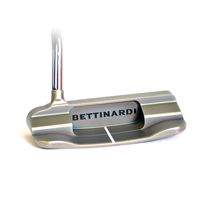
    Bettinardi putterMatt Kuchar is on to something. He may not be the one that invented his Arm-Lock putting style, but he is quickly making it famous. I once heard Johnny Miller claim on the air at Doral that he invented the Arm Lock style, but that’s disputable. Either way, he’s using it with great effect and I wanted to see what all the fuss is about.

    Kuchar used a unique Bettinardi putter to win more than $5.5 million in 23 starts on the PGA Tour in 2013 without missing a cut. That’s an average of $244,209 for every tournament he played. The guy is simply a check cashing machine, and his putting has a lot to do with it. A quick look at his putting stats reveals that he made 88.25 percent of all putts inside 10 feet for the season, and an incredible 97.56 percent inside 5 feet. For the season, Matt had 1268 putts inside that critical 10 foot scoring range, and made 1119.

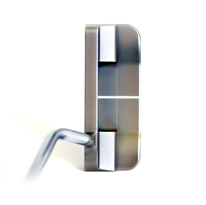
    Bettinardi putter - km1_toplineIf you don’t think those numbers are all that impressive, try it yourself! Line up 100 five foot putts on the putting green at your club and try to make 97 of them. Then try it on different courses with different grasses and greens rolling at 12 on the stimpmeter, and put $244,000 on the line. The PGA Tour is right on with their catchphrase: “These guys are good.”

    I just spent three paragraphs talking about Matt Kuchar and his putting stats because I think his putter has a lot to do with it. I would be skeptical reading this had I not tried this putter first hand and almost immediately put it in my own bag. Kuchar’s tool of choice is the Bettinardi Kuchar Model 1 Arm Lock putter. Designed specifically for him, it varies greatly from Bettinardi’s standard Kuchar Model 1. The special Arm Lock model has seven degrees of loft, 2.5 degrees of shaft offset, a 400g head weight and is 42″ long. Like all Bettinardi putters it is 100% milled in the USA and looks fantastic with a striking pewter PVD finish.

    First Impressions

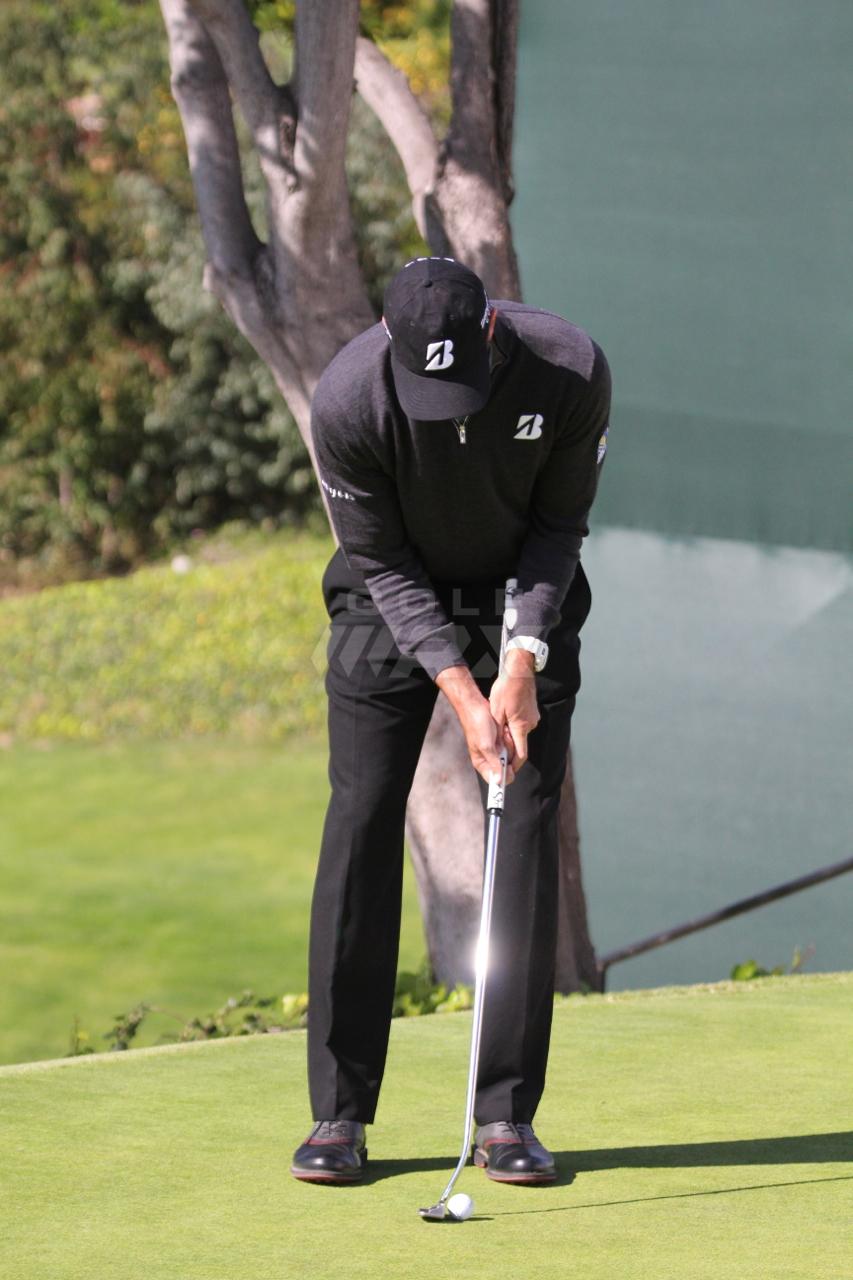
    At first glance, this Bettinardi putter looks weird. Most putters have between 3 and 4 degrees of loft and slight offset, but the Kuchar Model 1 Arm Lock has 7 degrees of loft and a large shaft offset, which makes it look strange when at address. This high loft and amount of offset is by design of course, because the arm lock style requires a pretty healthy forward press to anchor the top of the handle to a right handed golfer’s left forearm. Once locked in to the required stance, the putter sits perfectly square and is easy to align.

    The 400 gram mild carbon steel head and milled F.I.T. (Feel Impact Technology) face give this putter a classic Bettinardi feel. The ball rolls off the face with a soft feel, yet isn’t mushy like most insert putters. The weight and face balanced design make it very forgiving on off center hits, and the traditional Bettinardi hex face milling and beautiful pewter PVD finish gives the putter a classy look.

    Performance

    Photo Credit: GolfWRX Bettinardi putter
    Photo Credit: GolfWRX

    The Arm Lock putting style is such a radical departure from my standard putting style that it felt very strange and uncomfortable to get into such an extreme forward press with this putter. However, once I figured out where to grip down the shaft and how to align the putter properly, I found that the ball was rolling on target immediately. I was starting to see what made the Bettinardi putter so solid on short putts. The key to this style of putting is to make sure the shaft remains anchored to the left forearm (for righties) throughout the stroke. Imagine pulling with the left arm during the stroke with the right hand just along for the ride, and you’ll have the right feeling. The main drawback to the arm lock style is the same as any anchored putting style – distance control. I’m used to letting my wrists hinge a bit on long putts for better feel, but any anchored stroke eliminates the wrists and engages the big muscles of your shoulders instead. Distance control can be an issue with the anchored strokes, so a little practice outside 20 feet will go a long way to fixing that.

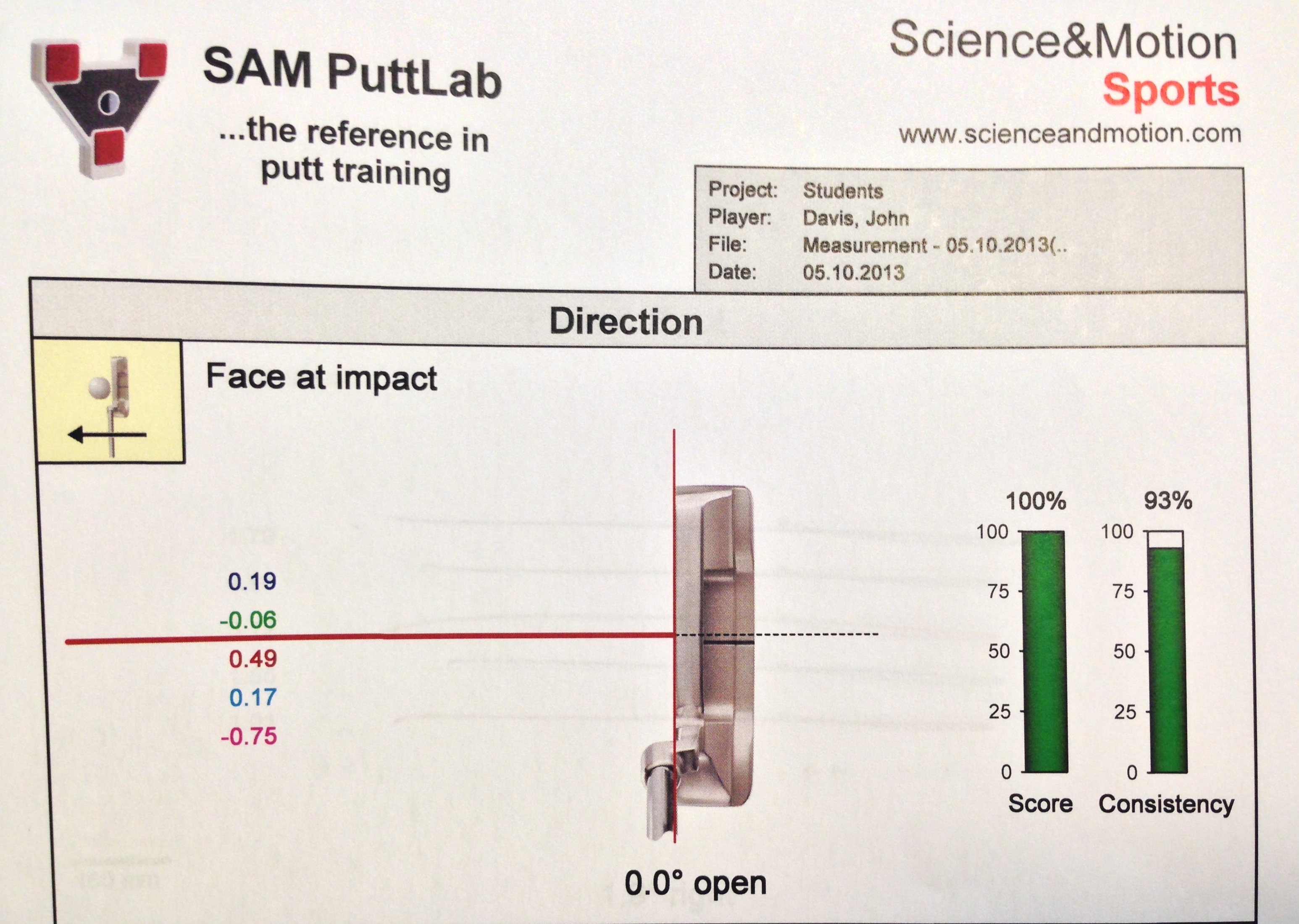
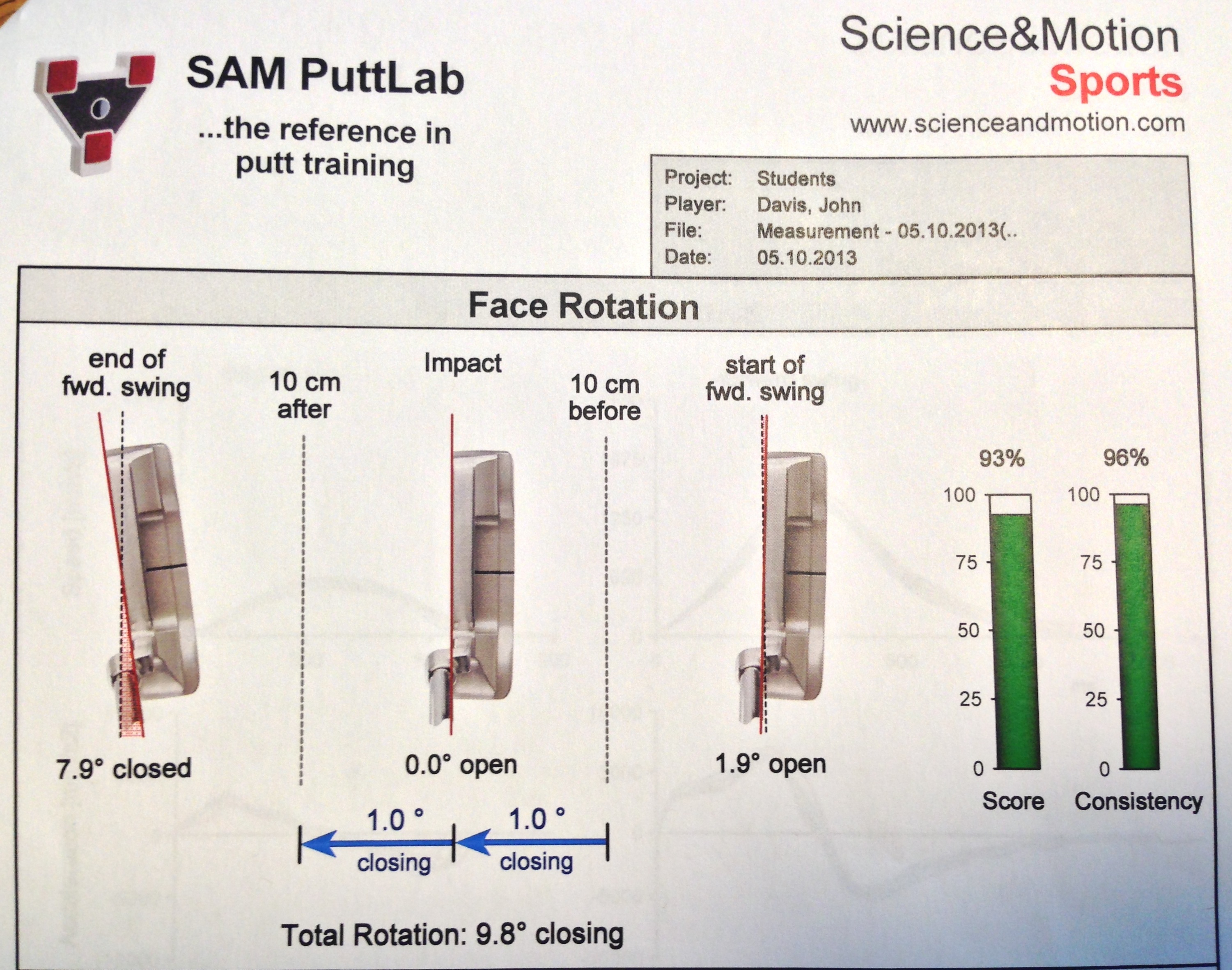
    SAM Putt Lab Data 1I was fortunate enough to have the Kuchar Model 1 Arm Lock in the bag during my visit to PGA Village in Port St Lucie, FL recently. There I met golf technology specialist Mark Drenga, PGA  who put me through the paces with the SAM Putt Lab. This amazing ultrasound tracking device measures 28 parameters of the putting stroke down to a tenth of a degree. During my session, the Kuchar Model 1 Arm Lock allowed me to keep the face almost perfectly square at impact, and I also had minimal face rotation (about 1 degree) before and after impact. What this means is my putts will almost always start on my aim line. The SAM Putt Lab also showed my stroke path going 1.2 degrees right, which is a slightly in-to-out direction. While not perfect, I am able to repeat this path with 99% consistency, which is key.

    SAM Putt Lab Data 2 - Bettinardi putterWhat does all this data mean? According to Mark who guided me through my session with the SAM Putt Lab, my stroke with the Bettinardi Kuchar Model 1 Arm Lock putter is on par with PGA Tour players. That was a huge ego boost for me. Unfortunately my speed control, green reading and aim are not quite at the same level, which explains why I don’t make as many putts as the guys on the PGA Tour. What I can say with a high degree of confidence is that the Arm Lock putter style has dramatically improved my putting inside 10 feet, just as it has for Matt Kuchar. I have played quite a bit lately (9 rounds in 12 days) and have seen the results of better ball striking converted into better scores because of my improved putting. My handicap has fallen a full stroke to +2.4 in just over 6 weeks due to improved scores with the Bettinardi putter.

    Conclusions

    Robert Bettinardi has taken his mastery of the flat stick to another level with the Kuchar Model 1 putter. Matt Kuchar has wielded this wand with great effectiveness on the PGA Tour, and now everyone can try it out for themselves. The anchored arm lock style is USGA legal also, since the butt of the club is not static. It swings with your arm, so by definition isn’t illegal like belly and long putters who’s anchor point doesn’t move. This putting style isn’t for everyone, but it has worked wonders for me and I look forward to getting better with it at longer distances. The Kuchar Model 1 Arm Lock putter is available at select Bettinardi dealers around the country. To find a dealer, visit Bettinardi’s website for a complete list. MSRP for the Kuchar Model 1 Arm Lock is $375.