Tag: Fitness

  • Swing Oil – Supplement Science or Clever Marketing?

    Swing Oil – Supplement Science or Clever Marketing?

    Swing Oil“Swing Oil” is a slang term golfers sometimes use referring to a stiff drink or painkillers to help them loosen up to play golf. In my personal experience, when I talk about taking some swing oil it usually means popping three Advil about an hour before teeing off. I have a friend who’s version of swing oil is downing a spicy Bloody Mary before the round. Whatever your definition of swing oil is, the folks at Back 9 Beverages have a new one for us.

    What Is It?

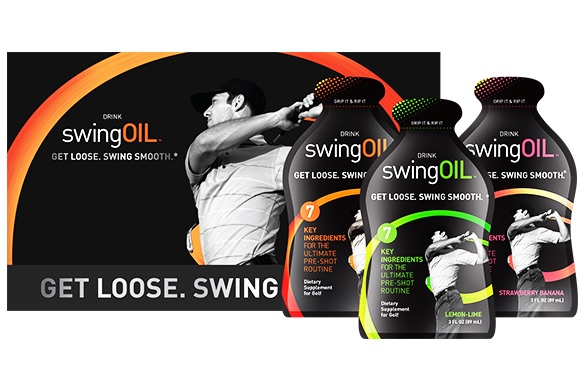
    Officially, Swing Oil is a supplement drink specifically for golfers that promotes flexibility and focus. Going beyond physical skill and endurance, Swing Oil exists to help you with the mental aspects of the game like focus and alertness so you can play your best. How does Swing Oil help golfers? Each 3oz drink pouch provides 7 key ingredients to help you get loose and stay focused for 18 holes.

    What’s In It?

    • GLUCOSAMINE (100mg) & CHONDROITIN (50mg) – Helps you loosen up and stay loose. Found naturally in our joints, bone marrow, shellfish, and fungi. Glucosamine helps rebuild cartilage and many people take it as a supplement to treat arthritis and osteoarthritis.
    • TURMERIC (40mg) – This spice often used in Middle Eastern cuisine is said to have anti-inflammatory properties, although there isn’t much scientific evidence for use of turmeric as a therapy for inflammation.
    • TAURINE (100mg) – Taurine is a type of amino acid found throughout the body, particularly concentrated in the brain, eyes, heart and muscles. It is commonly used in energy drinks as a low calorie energy booster.
    • CITRULLINE MALATE (100mg) – This hot new supplement for body builders is a non-essential amino acid just like Taurine. Citrulline Malate is thought to reduce levels of lactic acid and ammonia which is produced during physical activity. In layman’s terms, Citrulline Malate helps your body recover from a workout faster.
    • GINSENG EXTRACT (100mg) – Ginseng has been used for thousands of years in Chinese traditional medicine. In terms of benefits, ginseng is supposed to help focus and concentration.
    • RHODIOLA ROSEA EXTRACT (50mg) – Rhodiola Rosea – also known as “golden root” – is an adaptogen herb. This group of plants can help your body adapt to physical, chemical and environmental stress, and rhodiola is thought to be one of the most effective in this family.

    In English Please!

    To recap, Swing Oil contains ingredients to help you loosen up before your round, keep you loose all day, give you a boost of energy, help you focus, concentrate and control stress, and help your body recover once the round is over. It’s important to note that the usual disclaimer that comes with any dietary supplement is also applicable for Swing Oil: “These statements have not been evaluated by the Food and Drug Administration. This product is not intended to diagnose, treat, cure, or prevent any disease.” Now that the legal matters are out of the way, we get to the important question.

    Does It Work?

    Does Swing Oil work as advertised? If you ask me it does. Like many people, I normally take 600mg or 800mg of Advil (Ibuprofen) before a round to help me loosen up. I would prefer not to take it, but my game suffers demonstrably when I don’t and maintaining a +1 handicap without much practice is hard enough. To see if Swing Oil really works, instead of taking Advil, for six weeks I drank two 3oz pouches of Swing Oil before playing and one at the turn. In that time I played 11 rounds, including three tournament rounds. 8 of the 11 rounds I played were at par or better, with five rounds in the 60s. In that time my USGA handicap index went from a +0.2 to +1.5. (I’ve since slid back to +0.8 as of 4/15/2017)

    Now, it’s entirely possible that I went on a temporary hot streak like many golfers do, but this hot streak started and ended about the time I started using Swing Oil. Could it be a simple placebo effect? I’ll let you make your own determination. While the effectiveness of any nutritional supplement depends largely on who’s taking it, I think for me it had a positive effect. My testing was obviously not scientific in any way, but my observations can be summarized with the following:

    • Swing Oil alone isn’t as effective as Ibuprofen for use as an anti-inflammatory. This isn’t a surprise, but I think it’s worth noting. If anything Swing Oil is a good complement to Advil, and may reduce the need to take as much as I do to get the desired effect. Perhaps in the future I’ll combine Ibuprofen and Swing Oil to get the benefits of both!
    • While taking Swing Oil, I felt alert and mentally sharp. As advertised, Swing Oil helps you stay alert and focused for 18 holes. This is the single most important benefit of any supplement for me. Eliminating mental errors by staying sharp for 18 holes can save me 3 to 6 strokes. Everyone makes bad swings, but for low handicap golfers and professionals, being patient and making good decisions on the golf course often makes the difference between a round in the mid-70s and one that is under par.
    • Swing Oil tastes pretty good. I wasn’t a huge fan of the Strawberry-Banana flavor, but I enjoyed the Orange flavor. Lemon-Lime was my favorite. Many supplement drinks taste chalky or medicine-like, but Swing Oil just tastes like a sports drink, albeit with a thicker consistency a bit more like a light gel. Swing Oil goes down smooth and tastes great so you won’t dread taking it like those horse pill supplements.
    • Swing Oil is a bit pricey. Like many specialized supplements, they can get a little expensive. A 12-Pack on their website goes for $34.95, which comes out to $2.91 per pouch. If taken as directed, you have one before playing, one during the round and one after for recovery. For a once a week golfer, a 12-pack is therefore a one month supply. Buying in bulk saves you some money however. The 60-pack sells for $159, which comes to $2.65 per pouch. Shipping is free.

    Team Swing Oil

    PGA Tour player and former world #1 Jason Day endorses Swing Oil, and several players on PGA Tour Champions are using it. That’s gotta be worth something, right? Kenny Perry gave Swing Oil a fantastic endorsement recently during the 3M Championship, and his colleague Gene Sauers claims he hasn’t taken Advil before playing since switching to Swing Oil.

    If you need something to help loosen up and stay sharp on the course, you may want to try Swing Oil. The price may be a bit steep for some, but if it works you’ll probably make that money back from your buddies anyway!
  • A New Model of Learning Golf

    training2Without a doubt, golf and fitness have been inextricably connected.  The benefits of working out specifically for golf have been highlighted time and again by the top professional golfers in the world.  While there are many different types of golf swing philosophies, there is still a common basic level of physical ability necessary to perform the full golf swing.  Amateur and recreational golfers now understand the simple fact that physical limitations such as poor flexibility and a weak core can affect their ability to perform an efficient, consistent golf swing no matter which swing model they are learning.  I recently became more aware of this reality when I got a new middle aged client that had NEVER played golf before and wanted to learn.  Realizing how important his body was to playing the game, he signed up for 6 weeks of golf fitness training with me at the same time as he signed up for 6 weeks of golf swing lessons from a PGA professional teacher.

    In light of these connections, golfers must find a way to analyze themselves from both a physical and technical standpoint.  One way to do this is to participate in a golf fitness screen.  While many different medical and fitness professionals are selling their own golf specific screens, there is no doubt in my mind that the Titleist Performance Institute (TPI) has created the current gold standard screen.  I have used this screen hundreds of times and I know that when I am completed with the TPI physical tests I will have all the information I need to develop a corrective exercise program for the golfer.  The screens will assess all the key movements and muscles used in the swing as well as looking at an individual’s posture, balance, power, and patterns of movement.  After assessing these areas, the TPI fitness professional will then prescribe exercises and stretches designed to correct the physical limitations.  Some of these exercises will be available through an online program that has video descriptions and pictures of the exercises that are all downloadable for printing or to an IPOD or other media device for portability.  Other exercises may be provided by your TPI trainer based on their own experiences with golfers.   In many cases they may be even more specific because the trainer has spent time learning from your local golf swing teaching professional and is aware of the necessary physical requirements of that teachers swing philosophy.

    Once you have begun correcting your physical limitations, you will then return to your PGA professional and learn how to integrate your new abilities into the golf swing.  At this point, you are now ready to move on even further with your golf fitness trainer because you will inevitably continue seeking improvements in your game, especially in the areas of increasing power and distance off the tee.

    tpi-certified-logoAs you can see, I am describing a progressive pattern of training that is based on achieving basic levels of movement with your TPI program and then moving on to more sport specific power fitness training all the while as you are advancing your swing efficiency by working with your PGA teaching professional.  In my opinion, this is the new model way of learning and improving in the game of golf.  Obviously, there are other very important factors in the game including equipment analysis, mental training, and medical care specific to physical injuries that may limit ability in golf.  But initially the only requirement is to have an expert that can help you understand how to swing the club correctly and an expert that can help you understand how to move and train your body to achieve those key swing positions.


    Sounds easy enough, but really all we can do as teaching professionals is create the “right environment” for potential success; you the student are in control of the outcome of success or failure.  So if you really want to get better at golf, I believe you should seek out these professionals and get to work on your physical and technical abilities.  The game is just easier to learn when you get the right information and motivation.  Good luck on your journey, and be tenacious in your pursuit of perfection! In Health, Scott Shepard, MSPT CSCS TPI Scott Shepard is based in Central Florida and has an office in Lake Mary, FL. For more information on Scott and his golf specific fitness and injury rehabilitation programs please visit www.planeperformance.com or contact him at 407-222-7489. < p style="text-align: center;">Check out Scott's other great articles! Foam - Thats How I Roll - Golf specific Mobility

    Don't forget to subscribe to our updates and email to get the latest content delivered to your inbox!

  • “Foam, that’s how I roll” – Golf Specific Mobility

    scott-homepageHello! My name is Scott Shepard and I am a trainer and physical therapist for golfers.  I have been working specifically with golfers for the past 5 years of my practice including top players from the LPGA, Junior Golf, Nationwide Tour, Hooters Tour, and other competitive and recreational golfers.  In light of the recent explosion of golf specific fitness, I would like to comment on my personal beliefs on training golfers.

    Golf, like all sports, requires a certain amount of physical skill to allow for optimum performance. Golf, unlike many sports, can be played and enjoyed for a lifetime. With that being stated, I feel that training golfers is similar to training other sports in the sense that your workouts need to focus on increasing overall muscular flexibility/joint mobility, muscular endurance, cardiovascular endurance, core stability, balance, and explosive power capability.

    However, golf training is unique in the sense that we have to focus more on long term health than we do on short term gains. Let’s face it, football players only play into their late 30’s/early 40’s if they are lucky or cheating or Brett Favre.  Obviously, the physical contact of the sport is the main factor for this body breakdown, however many of the physical training methods add to this deterioration.

    Recently, top athletic training centers have recognized this and are focusing on spending more time working on recovery methods and mobilization exercises that actually allow the body to heal after intense workouts and prolonged sports practice. Basically it’s working out in a way that allows you to play and practice longer and with less chance of injury.  I believe strongly in this recovery training and I make sure that all of my clients are incorporating these methods into their program.

    Golf Training by Core Performance

    The concept goes far beyond the few minutes of stretches you usually do after your workouts.  In order to really improve mobility you have to stretch the soft tissues (muscles, tendons) but you also have breakdown any adhesions in these structures.  Adhesions occur when you have prolonged stress to structures.  Most people have these “knots” somewhere in their body, usually around the shoulders and neck region.  Whether you play golf, football, or work in a factory, your body does not respond well to any prolonged stressful positions.  Some methods to reduce these adhesions include using foam rollers, massage sticks, pressure relief tools, and having professional manual therapy treatments.

    An easy way to get started is to use a foam roller which is a dense Styrofoam roll that provides deep self massage to muscles when you roll your body over the foam.  Initially it can be quite painful, but as you work on it over time your muscles really loosen up and you are able to relax further.  This can actually help break up those adhesed areas and allow you to get more out of your stretching routine.  Check the photos of one of my clients working his middle back and lateral hip muscles.  Foam rollers are becoming more available locally, but I buy mine from PerformBetter.com, they have everything for fitness.

    I have always liked the quote that states, “would you rather train for an apparent change or a lasting change”. Only by addressing the imbalances and stressors present in the body can we truly allow for lasting change to occur.  So if we can spend some time getting to know our foam rollers it will help us all to continue playing this game at a high level throughout the “golf span”, which by the way is much more important than the “life span”.

    In Health,
    Scott Shepard MSPT, CSCS, TPI

    tpi-certified-logo

    Scott Shepard is based in Central Florida and has an office in Lake Mary, FL.  For more information on Scott and his golf specific fitness and injury rehabilitation programs please visit www.planeperformance.com or contact him at 407-222-7489.