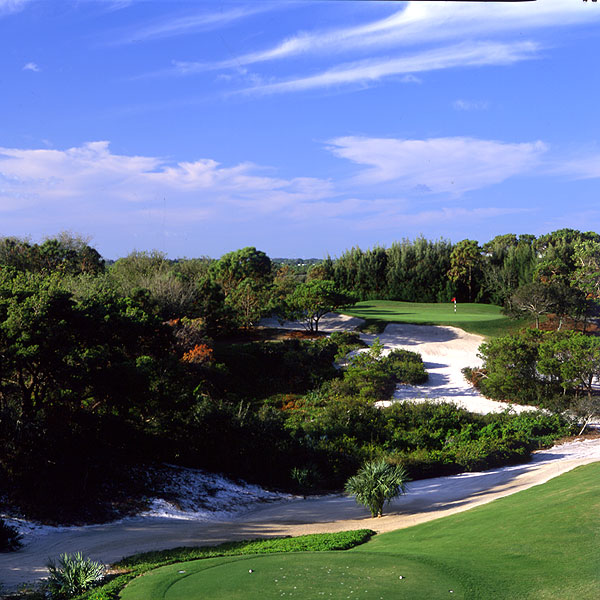
Welcome to part two of my story about the Jupiter Hills Club in Tequesta, Florida. Many people that play golf never get to play at an ultra-exclusive private facility. I am fortunate to have played there on a few occasions and my experience is one that I’ll never forget, so I felt compelled to share the experience with everyone. If you missed part one of the story, you’ll get a lot of background about the courses themselves, and I suggest you go back and read it if you haven’t already.
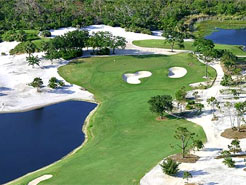 My experience at the Jupiter Hills Club started in July of 2007 when my partner and I qualified for the Florida State Four-Ball Championship being held there, and continued in June of 2008 when I was fortunate enough to qualify for the Florida State Amateur Championship, also being held at the Jupiter Hills Club. The FSGA has a habit of using the site of the Four-ball Championship as a test run for the Amateur Championship the following year. Having played the Four-Ball Championship there in ’07, I was highly motivated to return in ’08 for the Am. As I described in part one, I arrived a week early to play the Village course because the previous year’s Four-Ball didn’t play there, and I hopped on the Hills course in the afternoon mostly to see if there had been any changes.
Jupiter Hills is a very traditional club, in that the history of the game and the long standing traditions were kept in play when making policy. Some rules are in place here that I think should be adopted by every club.Members and guests are not permitted to change shoes in the parking lot, and with the incredible locker room available to members, I don’t understand why anyone would want to either. Of course, hats are not permitted in the clubhouse, and a jacket is required to enter the dining room. No tee times are made at Jupiter Hills. Indeed, with an average of 10 to 12 carts per day spread out on the 36 holes during the summer months, it’s not hard to see why they aren’t needed. According to one of the members of the cart staff I spoke to, during the busy winter months when most of the members are in town, the number of rounds played averages somewhere in the 50 to 100 per day. Again, spread over 36 holes this is hardly a busy course. Many muni tracks in Florida will see 200+ rounds daily over 18 holes in the winter. Finally, my favorite regulation that the Jupiter Hills Club has put in place – cell phones are not permitted on the premises at all, and should be left in the car or at home. (cue Handel’s Hallelujah!) Now, if only we could convince all the other golf clubs around the country to make this the rule, not the exception…
As had been the case in 2007 for the Four-Ball, the club staff treated me, a total stranger off the street, like a long time member and made me feel like this was my club for the brief time I was a guest. After arriving at the club I was greeted by the staff from the Florida State Golf Association. I signed in and collected my hat and hat pin and went inside as the cart staff loaded my bag on the cart. The pro shop staff remembered my name from the week before, and to me that is impressive in today’s disconnected world of customer disservice. As I entered the men’s locker room, the hallway opened to a large lounge complete with leather sofas, poker tables, LCD Televisions and even a private bar. The walls are covered in cherry wood paneling and a dark carpet lines the floor, giving the room the look and feel of a cigar lounge or classy pool hall. The cherry wood theme continues into the locker room, where the floor to ceiling lockers are emblazoned with brass name plates with the owners’ names. The shower and bathroom facilities feature wall to wall marble floors and granite counters. No expense was sparred making the locker room areas comfortable. Indeed, I would have trouble ever going home after a round if I was a member there! For the week of the 2008 FSGA Amateur Championship, I was assigned Bobby Orr’s locker. That’s Hockey Hall of Famer Bobby Orr of the Boston Bruins. The shoe service was also world class. I have not seen my shoes look and smell so good since I unwrapped them for the first time.
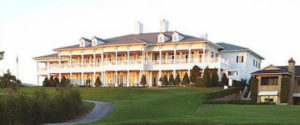
Being treated like a member at a club like the Jupiter Hills Club, even for only a few days, was a special treat. The 40,000 sq/ft clubhouse that sits on the highest point in South Florida is a work of art in itself, and the amenities are truly world class. Even if the two golf courses are both very high on my list, I would enjoy just hanging at the clubhouse with the boys in the men’s lounge! I am pretty certain I’ll never be a member there. My information puts the initiation fee at or around $275,000 and the yearly dues well into five figures, not including the certainly very lofty restaurant charges. The club has a no tipping policy, and the cart staff are actually salaried. The gentleman I got to know had been on the cart staff there for 17 years. I don’t have any idea what they get paid, but I can imagine the gifts from the members and fringe benefits of working there must make it a rewarding, if not interesting career choice.
The Jupiter Hills Club is not the most private or exclusive club in the country; It doesn’t have the best golf course and amenities, but it has a very unique and perfectly balanced blend of character and class that makes it among the elite private clubs in the nation. Like most places, the staff makes or breaks the facility. The Jupiter Hills Club shines again, with everyone I encountered being very friendly, helpful and professional. They pride themselves on the fact that members and staff are trusting and respectful of one another and there is no snobbishness or elitism towards anyone. If you ever have a chance to be a guest there, to me it is worth a trip across the country to spend a few days with the folks in Tequesta to see how the other half really live.