 Here at intothegrain.com, we get plenty of training aids and swing gadgets to try out. Some of them work great, and others… not so much. When I first saw the ads for the Tour Striker I thought it would be just like many golf training aids that claim to fix your swing, so I paid it no real attention. Then, at the PGA Merchandise Show and Demo Day at Orange County National in Orlando I got to actually try it, and my impressions changed. A friend of mine happened to be a rep for Tour Striker and I was able to bring home a few units to test out for this review.
There are several models of the Tour Striker available. The regular Tour Striker is targeted for mid-to-high handicap golfers and slower swing speeds (under 90 mph with driver), while the Tour Striker Pro is generally geared for players with higher swing speeds and a handicap of 10 or less. There is a Tour Striker for women and younger players also, with a graphite shaft that is slightly shorter (35 inches vs. 36 inches) which is more appropriate for women and juniors. The last model, and the one I was most interested in is the Tour Striker Pro X. This model is basically the same as the Tour Striker Pro, but the sweet spot is only the size of a quarter. This one is designed for low handicap golfers who want a real challenge. More specifically, there are 6 models available: The Tour Striker 8 iron, the Pro 7 iron, Pro X 7 iron, Pro 5 iron, 56 degree wedge and Tour Striker Ladies/Junior. The Tour Striker sells for $119.99 for graphite and $99.99 for a steel shaft.
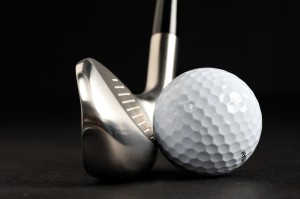 So what’s the big deal with the Tour Striker? If you’ve seen their commercials on the Golf Channel, you know that the concept behind this training club is to promote forward shaft lean at impact, which produces a descending hit, a boring trajectory and the solid strike that is desired by touring pros and top amateurs. If you watch good players and pros, they all swing with the hands leading the club. To help train the golfer in producing this impact position, the Tour Striker was designed with the leading edge of the club raised up a half inch or more from the bottom of the club. From this design came a club in which the only way to get the ball airborne is to use a descending hit with the hands ahead of the club, so that the leading edge is lowered to get under the ball. If the required swing is not made properly, you’ll hit the ball with the bottom of the leading edge, producing a rolling dribbler that resembles a topped shot.
 .
.
Now that you know what the concept is behind the tour Striker, does the thing work? Yes! I went to the range to give it a try in the hopes of not making a fool out of myself in front of the other golfers. I brought the Pro 5 iron and the Pro X 7 iron to try out. After a warm up with my own clubs I started with the Pro 5 iron. Setting the Tour Striker down behind the ball is strange, because it’s not like any other club I’ve hit before. It’s also intimidating with the raised leading edge. Initially hitting shots with the Pro 5 iron wasn’t too hard, but I had to make sure I made a good swing to make solid contact. I’m a plus handicap player, so leading with the hands is a natural move that I make already. This made hitting the Pro 5 iron relatively easy. However, you still have to be on your toes when hitting the Tour Striker. Making a swing that would produce a thin shot with a normal club instead results in a low worm burning roller that is sure to turn heads. You must hit down on the ball to get a good result.
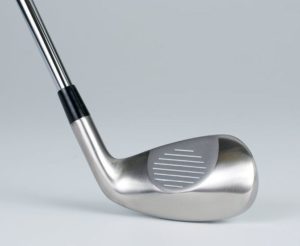 After having success with the Pro 5 iron, I moved on to the Pro X 7 iron (shown at left) with a good deal of confidence. Setting the 7X down behind the ball, I noticed that the quarter-sized sweet spot seems much smaller when you set it down behind the ball. Clearly this model was designed for players who make consistent contact. Confident but apprehensive, I made a few swings. Of the first four balls I hit, 1 of them got airborne. The Tour Striker Pro X 7 iron is no joke. You have to make a good swing with a descending blow and manage to hit a tiny sweet spot to get the ball in the air. I found shots hit just a bit on the heel curved way left. Solid shots flew high and straight, like a normal 7 iron would. I found the best way to use this club was by hitting a few balls with the Tour Striker, then switching to my normal 7 iron for a few, then back and forth. Once you get in a groove with the Tour Striker, it’s a pretty good feeling.
The Tour Striker is cast from 431 steel and should last a long time. They are available in steel and graphite shafts. The stock steel shaft was more than adequate for my use, but if you are serious about using the club extensively in your practice, I would suggest having the club re-shafted with the same shaft and stiffness as your irons and bent to your specs for lie angle also. In summary, of all the swing aids and training devices I’ve ever tested, this may be the best. The Tour Striker is simple to use, easy to carry with you, doesn’t need batteries or a computer to work and provides instant feedback on good and bad swings alike. Perhaps the best selling point for this training aid is the fact that everywhere I play people are always reaching into my bag to try it out. I play golf with players ranging from high-handicap amateurs to touring pros, and they all enjoy testing themselves with the Tour Striker.
I recommend the Tour Striker to all levels of golfers, but those who will benefit the most from it are mid to high handicap players. This level of golfer have not yet learned to hit the ball with a descending blow and lead with the hands, and the Tour Striker is ideal at showing you how to produce this impact position in real time. There is a model available for all abilities too. Beginning golfers can start with the Tour Striker 8 iron, and work up to the Pro X 7 iron for the maximum challenge. Through their affiliate program, readers interested in purchasing a Tour Striker can use the following link to the Tour Striker Store, or simply click on the banner below.
.
Subscribe to our email updates! You’ll get the latest fresh news, reviews and stories delivered right to your inbox or RSS reader, and automatically be entered in our latest contests and giveaways! We are 100% SPAM FREE! Also, don’t forget to check in with our Facebook fan page for exclusive content and get involved by leaving us comments on what you think!